
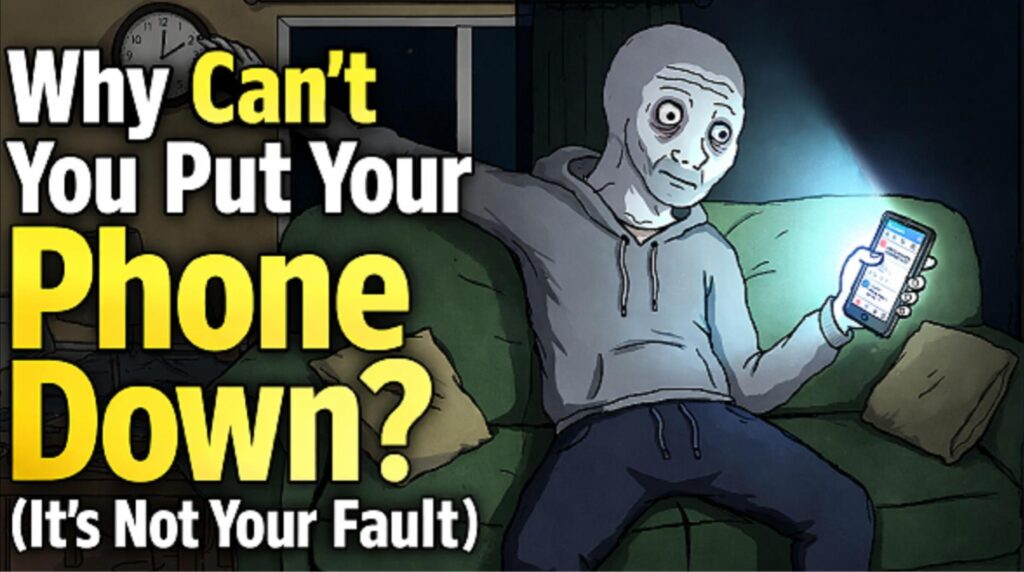
You pick up your phone to check the time.
Forty-five minutes later, you’re watching a video about a guy restoring a rusty knife in rural Japan.
You don’t even like knives.
This isn’t a willpower problem. It’s not because you’re lazy or undisciplined.
It’s because your phone was specifically engineered — by very smart, very well-paid people — to do exactly that.
The concept behind it: the attention economy.
And once you understand how it works, you’ll never look at your screen the same way.
Your brain runs on a chemical called dopamine.
Most people think dopamine is about pleasure. It’s not — not exactly.
Dopamine is about anticipation. The chase. The possibility of a reward.
When you don’t know what’s coming next, dopamine spikes harder than when you do.
That’s why a slot machine is more addicting than a vending machine. The vending machine always gives you chips.
The slot machine might pay out. Big difference.
Your phone is a slot machine.
Every time you pull down to refresh — Instagram, TikTok, email — your brain fires dopamine before it even sees what’s there.
It’s not the content that hooks you. It’s the uncertainty.
You’re not scrolling because you enjoy it. You’re scrolling because your brain is chasing a hit that mostly doesn’t come.
And the apps know this. They built the uncertainty in on purpose.
Here’s the business model, stripped down.
Every app on your phone exists to capture your attention and sell it to advertisers. That’s it.
More time on app → more ads shown → more revenue.
Which means every product decision — the infinite scroll, the autoplay, the little red notification badge — was made by an engineer whose KPI was session length.
This is the attention economy. Your focus is the product. These companies are optimizing to extract as much of it as possible.
Netflix’s former CEO once described sleep as their biggest competitor. That’s not dark humor.
That’s strategy.
You’re not weak for getting sucked in. You’re up against teams of engineers running thousands of A/B tests specifically designed to keep you on the app five minutes longer.
Understanding that changes how you think about it.
One of the most effective tools they use: notifications.
A notification is an external trigger — something outside you interrupts whatever you’re doing and pulls you back into the app.
Research on attention and task-switching suggests that interruptions take a meaningful toll on your ability to refocus.
Even a brief phone check can disrupt a task significantly.
The exact numbers vary by study and person, but the pattern is consistent: interruptions are more costly than they feel.
And most people get dozens of notifications a day. Most of them weren’t requested.
At scale, that’s not just annoying. It’s systematically fragmenting your ability to think deeply about anything.
So what? Notifications aren’t features.
They’re interrupts. And every app defaults to maximum notification volume. You have to manually opt out.
Nobody’s going to do that for you.
Back to the slot machine.
Psychologists call this pattern variable ratio reinforcement. You get rewarded on an unpredictable schedule.
It’s the most powerful behavior-conditioning mechanism known. More powerful than fixed rewards.
Harder to extinguish than almost any other pattern.
Your phone runs on this everywhere.
Pull to refresh: sometimes a great post, usually nothing.
Open a message: sometimes exciting, usually not.
Check your likes: sometimes a spike, mostly flat.
The brain doesn’t habituate to variable rewards the way it does to predictable ones. It keeps firing.
It keeps wanting to check.
And the rusty knife video? You didn’t search for it.
The algorithm detected that you once paused on a similar clip,
and served you progressively more of that content until you were 45 minutes deep into a niche you didn’t know existed.
The algorithm doesn’t show you what you want. It shows you what keeps you watching.
Not a “put your phone in a drawer and read Tolstoy” lecture. Practical only.
The actual research on reducing compulsive phone use points to environment design,
not willpower.
Remove social apps from your home screen. More taps to open = meaningfully fewer opens.
Turn off all non-essential notifications.
Default settings on every app are set to maximum extraction. Change them manually.
Try grayscale mode. Color is part of the visual reward. Gray is measurably less stimulating.
Charge your phone outside your bedroom.
The last thing you see before sleep and the first thing after shouldn’t be an engagement machine.
None of this is about discipline.
It’s about changing the default conditions so your behavior changes automatically.
You can’t out-willpower a billion-dollar engineering effort. But you can stop making it easy for it to win.
Dopamine is about anticipation, not pleasure — your brain chases the possibility of a reward.
Variable rewards are more addictive than predictable ones — that’s why the refresh feels irresistible.
The attention economy means apps are optimized to extract your focus, not serve your interests.
Notifications fragment your attention at scale — the cost is higher than it feels.
The algorithm knows your patterns better than you do and uses them to extend your session.
Willpower isn’t the solution — environment design is.
Your phone isn’t the enemy. But the default settings aren’t your friend either.
Use it like a tool. Configure it like one.
If your screen time went up while watching this — that’s either ironic or a live demonstration.
Either way, subscribe. One notification you might actually want.
Watch on YouTube
