
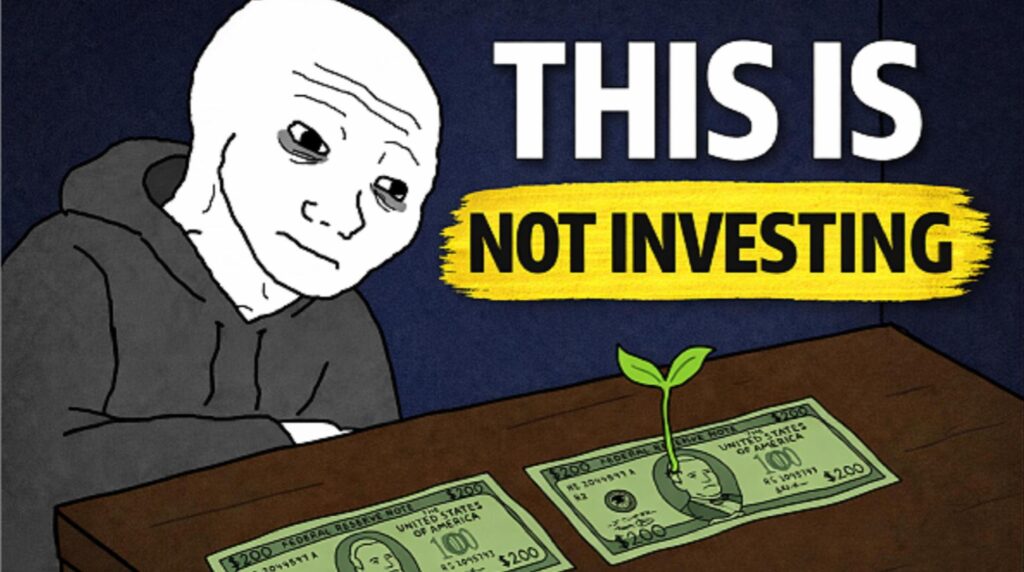
You already have money.
You just don’t know it yet.
By the end of this, you’ll understand why the timing of when you start investing matters more than how much you invest.
And the math behind it is going to make you feel a little sick.
Here’s the concept: compound interest. It means your money earns returns.
Then those returns earn returns. Then those returns earn returns.
It sounds simple.
It is simple.
That’s the problem.
Simple things are easy to ignore.
Let’s use a name.
Call him Derek. Derek is 22. He puts $200 a month into a basic index fund.
He does this for 10 years. Then he stops completely. Never adds another dollar.
Derek at 22 was not making good money. He was just consistent.
Here’s where it gets interesting.
His friend Marcus starts at 32. Same $200 a month.
Same index fund. But Marcus keeps going. He invests for 30 years straight.
Never misses a month. Marcus puts in three times as much money as Derek total.
Three times. At 62, Derek still has more.
That’s not a typo. Derek wins. By a lot.
This is what compound interest actually does. It doesn’t reward the person who invests the most.
It rewards the person who starts first. Time is the variable that matters.
Not discipline. Not income. Not stock picks. Time.
If this is making sense, hit like. It genuinely helps this reach people who need to hear it.
Now let’s talk about why this feels impossible to act on.
Your brain is bad at understanding exponential growth.
Research in behavioral economics shows that humans naturally think in straight lines.
We expect things to grow gradually and evenly. Compound growth doesn’t work that way.
It’s slow at first. Painfully slow. Then it accelerates so fast it looks fake.
The first few years of investing feel like nothing is happening.
That feeling is accurate. In year one, your $200 a month becomes about $2,500.
That’s not exciting. That’s a used laptop. Your brain registers this as: pointless. So people stop.
But the math doesn’t care about your feelings. The growth is still compounding underneath. Quietly.
Every month. The account you ignored for a decade is doing more work than the savings account you check every week.
Here’s the weird part. The last 10 years of a 40-year investment do more work than the first 30 combined.
The back half is where the real money is built. Most people never see it because they quit in year two.
Back to Derek.
In year one, his account grows by maybe $300. By year 35, that same account grows by more per month than he ever invested total.
He crossed a line where his money works harder than he does.
That line has a name. Some people call it financial independence.
Others call it the point where work becomes optional.
You don’t need to be rich to get there. Derek wasn’t rich. He was just early.
Okay. We’re almost done. But this last part is the one that actually changes behavior.
The enemy of compound interest isn’t bad investments.
It’s delay. Every year you wait costs you more than the year before. Not the same amount.
More. Because the years you skip at the beginning are the years that would have compounded the longest.
Waiting from 22 to 25 doesn’t cost you three years of returns.
It costs you three years of compounding on top of compounding on top of compounding.
The penalty for delay is exponential. Just like the reward for starting early.
Let’s recap. Compound interest means your returns earn returns.
Time matters more than amount. Starting at 22 beats investing three times as much starting at 32.
Your brain expects linear growth and gets bored waiting.
The last years of a long investment do the most work.
Delay doesn’t cost you a fixed amount. It costs you exponentially more the longer you wait.
One takeaway: the best investment move you can make today is not finding the perfect stock.
It’s starting before you feel ready.
If this hit different, subscribe.
The next video will hurt in the same useful way.
Watch on YouTube
