
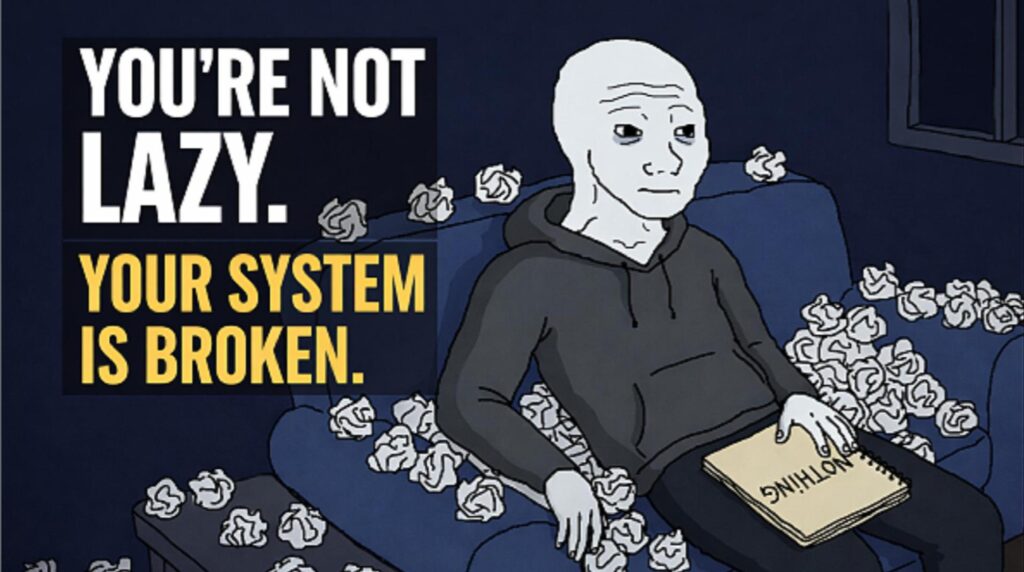
You’ve started over more times than you can count.
By the end of this, you’ll understand exactly why motivation always fails you. And it’s not because you’re lazy.
The system you’re using is just broken by design.
Here’s what nobody tells you. Motivation is not a personality trait. It’s a chemical event.
It spikes when something is new. It drops when something becomes routine. Every single time.
This is not a you problem. This is biology.
So when you decided to wake up at 6am, hit the gym, eat clean, and read 30 minutes a day all starting Monday — your motivation was genuinely high.
You felt it. That feeling was real. The problem is that feeling has an expiration date. And it’s about two weeks.
Here’s where it gets interesting.
The people who actually stick to things are not more motivated than you. They’re not more disciplined either.
They built systems that don’t require motivation to run. That’s the entire difference. Not willpower. Systems.
Let’s use one example. Call him Jake. Jake wants to go to the gym.
Monday, motivation is high. He drives there, works out, feels great. Tuesday, same. By Thursday, he’s tired.
He tells himself he’ll go tomorrow. Tomorrow becomes next week.
Next week becomes “I’ll restart in January.” Jake didn’t fail because he was weak.
Jake failed because he was relying on a feeling to make a decision every single day.
But here’s the weird part. The decision itself was Jake’s real problem.
Every day he had to decide: do I go or not? That decision costs mental energy.
Research in psychology calls this decision fatigue. The more decisions you make in a day, the worse each one gets.
Jake was spending willpower just deciding to go. He had nothing left to actually work out.
If this is making sense, drop a comment — tell me what you’ve quit and restarted the most. I read them.
Now here’s what actually works.
Remove the decision. That’s it. That’s the whole system.
If Jake schedules the gym for 7am Monday, Wednesday, Friday — it’s not a decision anymore.
It’s an appointment. He doesn’t ask himself if he feels like going. He just goes. The question is already answered.
This is called implementation intention.
Research shows that people who plan exactly when and where they’ll do something are significantly more likely to follow through than people who just intend to do it.
Not slightly more likely. Significantly.
The second thing that kills habits before they start is scale. You decide to go from zero workouts to six a week.
Zero to six. Your body isn’t ready. Your schedule isn’t ready.
And when you miss one day, the whole thing collapses because you built a perfect streak that couldn’t survive one real Tuesday.
Back to Jake. Jake restarts. This time, two days a week. Just two. The sessions are 30 minutes.
He leaves before he wants to. This feels too easy. That feeling is the point. Easy means he actually does it.
And doing it is the only thing that builds the habit.
Here’s the thing about habits. They don’t form from motivation. They form from repetition.
Your brain physically changes when you repeat a behavior. Neural pathways strengthen.
The behavior starts to feel automatic. But that process takes longer than two weeks.
Most people quit right before the automaticity kicks in.
Okay. We’re almost there. But this last part is the one that changes everything.
The goal is not to become a motivated person.
Motivated people are just people who automated the right behaviors early enough that doing them now costs almost nothing.
They’re not running on willpower. They’re running on habit. The hard part is already done.
So the move is this. Pick one behavior.
Make it small enough that missing a day feels embarrassing, not inevitable.
Attach it to something you already do. Go to the gym after work, not before a completely empty morning.
Do the thing before you have time to talk yourself out of it.
Two weeks is when motivation dies. It’s also when the real work starts.
Most people treat the motivation drop as a signal to stop. It’s actually a signal that the habit is about to form.
You just have to get through the boring part.
Let’s recap. Motivation is a chemical spike, not a personality trait. It always drops around two weeks.
The people who stick to things use systems, not willpower. Decision fatigue drains you before you even start.
Implementation intention — scheduling exactly when and where — works better than vague intent.
Scale kills habits before they start. Small and consistent beats ambitious and broken.
Neural pathways form through repetition, not motivation. The motivation drop is not a stop sign.
It’s the beginning of the habit.
One final thought: you don’t need to feel ready. You need to make the decision once and remove it from the daily negotiation.
If this hit, subscribe. Next video is going to make you question another thing you thought was your fault.
Watch on YouTube
