
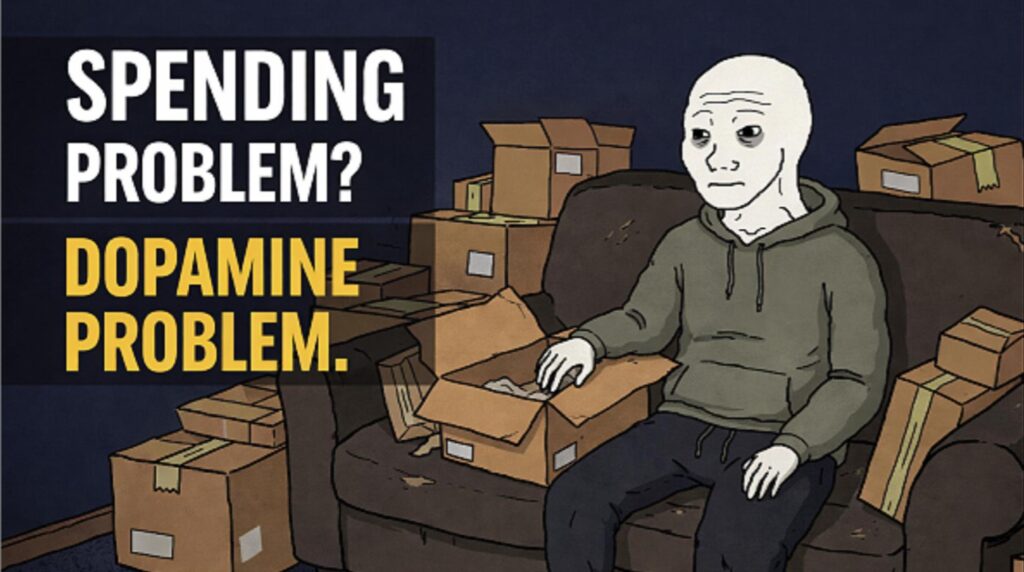
You didn’t need it. You knew you didn’t need it. You bought it anyway.
By the end of this, you’ll understand exactly why your brain is wired to spend money on things you don’t need.
And it has nothing to do with being bad with money. Your brain is doing exactly what it was designed to do.
Here’s the thing nobody explains. Buying something feels good. Not because you got the thing.
Because your brain releases dopamine the moment you decide to buy it. Not when it arrives.
Not when you use it. When you click purchase. That hit happens before the thing even exists in your hands.
Here’s where it gets interesting.
Your brain doesn’t care about the object. It cares about the anticipation.
Neuroscience research consistently shows that dopamine spikes during the wanting phase, not the having phase.
The chase is the reward. The arrival is the letdown. This is why you’ve opened a package and felt nothing.
The dopamine already fired. It’s gone.
Let’s use one example. Call him Ryan. Ryan is browsing his phone at 11pm. He’s tired. He’s a little bored.
He sees an ad for a jacket. He doesn’t need a jacket. He has four jackets. But he clicks it. He reads the reviews.
He imagines wearing it.
His brain is lighting up right now — not because of the jacket, but because of the decision loop he just entered.
Add to cart. Maybe I’ll buy it. Actually yeah. Purchase.
The jacket arrives four days later. Ryan opens it. Tries it on. It’s fine. He puts it in the closet. Done.
That moment of “it’s fine” is your brain realizing the chase is over. There’s nothing left to anticipate.
The dopamine window has closed.
But here’s the weird part. Ryan does this again two weeks later. Different product. Same loop. Same outcome.
His brain didn’t learn from the last time because it wasn’t looking for a lesson. It was looking for the next hit.
If this is making sense, hit like. It helps more people find this before their next impulse purchase.
Now let’s talk about the system that’s designed around this.
Every major retail platform is built to keep you in the wanting phase as long as possible. Infinite scroll.
Countdown timers. Low stock warnings. One-click checkout. These are not convenience features.
They are dopamine management tools. The longer you browse, the more anticipation builds.
The faster checkout removes friction so your rational brain doesn’t have time to interrupt.
The “add to cart” button exists for a reason.
It lets you experience the dopamine of almost buying without committing. Then the cart sits there. Waiting.
And your brain keeps returning to it because unfinished decisions create cognitive tension.
You feel slightly uncomfortable until you resolve it. The easiest resolution is to buy.
Back to Ryan. He starts noticing the pattern. Every time he’s tired or bored, he opens a shopping app.
Not because he needs something. Because browsing triggers the same dopamine loop as actually buying.
The app is free. The browsing is free. The purchase is where they get you.
This is the attention economy meeting consumer psychology. Platforms don’t sell you products.
They sell you the feeling of wanting. The product is just the exit ramp.
Okay. We’re almost there. This last part is the one that actually changes behavior.
Your brain has a negativity bias. Losses feel roughly twice as painful as equivalent gains feel good.
Retailers know this. That’s why sale pricing always shows the original price crossed out.
You’re not gaining a discount. You’re avoiding a loss. The framing does the work.
Your rational brain sees a number. Your emotional brain sees a threat.
So what do you do about it? You don’t fight the dopamine. You can’t. Instead, you add friction to the decision.
Leave items in the cart for 48 hours. Delete shopping apps from your home screen. Pay with cash or manually enter your card number.
Every extra step gives your prefrontal cortex time to catch up with your limbic system. Most impulse purchases don’t survive 48 hours of waiting.
Let’s recap. Dopamine spikes during anticipation, not acquisition. The wanting is the reward, not the having.
Retail platforms are engineered to keep you in the wanting phase. Add to cart triggers dopamine without committing.
Browsing when bored uses shopping as a mood regulation tool. Loss aversion makes discounts feel like emergencies.
Friction kills impulse purchases. Waiting 48 hours lets your rational brain vote.
One final thought: you’re not bad with money. You’re just running on hardware that was never designed for one-click checkout.
If this explained something you’ve felt but never understood, subscribe.
Next video is going to do the same thing to a different part of your life.
Watch on YouTube
