
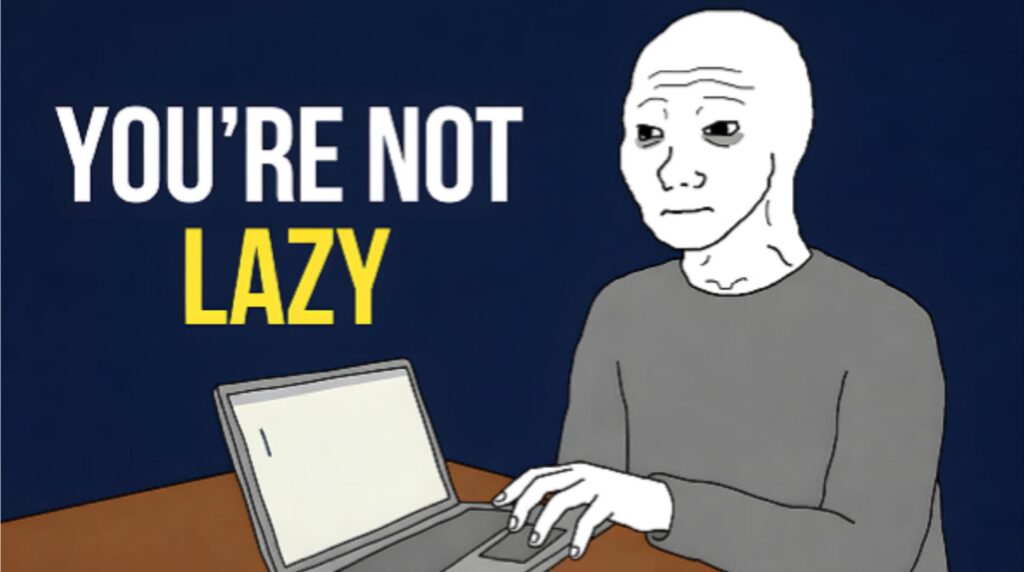
You’re not lazy.
You never were.
Lazy would actually be simpler to fix.
The real reason you procrastinate has nothing to do with work ethic.
It has everything to do with how your brain handles discomfort.
And once you understand this, you’ll never look at your to-do list the same way again.
Here’s what’s actually happening. Every time you avoid a task, your brain isn’t slacking off. It’s protecting you.
From what, exactly? We’ll get there.
Procrastination is your brain’s way of escaping a feeling. Not a task. A feeling.
That shift in framing changes everything.
Most people treat procrastination like a time management problem. They buy planners.
They set timers. They download apps. And none of it works. Because the problem was never about time.
It was about emotion.
Your brain has one core job. Keep you away from discomfort. Pain, embarrassment, uncertainty, boredom.
Your brain treats all of these the same way. Threat detected. Avoid.
When you look at a task and feel a spike of anxiety or dread, your brain files that task under one category.
Danger. And it will do everything in its power to steer you somewhere safer.
Somewhere like your phone.
That’s not weakness. That’s your nervous system doing exactly what it was designed to do.
The problem is it was designed for a world where threats were physical.
Not for a world where the threat is a blank document with a blinking cursor.
Here’s where it gets interesting.
Research in psychology has shown that procrastination reliably reduces negative emotion in the short term.
You feel better the moment you close the tab. That relief is real. And your brain remembers it.
So the next time the same task appears, your brain already knows the solution. Avoid it. Feel better.
Problem solved.
Except the problem is not solved. The task is still there. And now it has one more day of dread attached to it.
This is the procrastination loop. Discomfort triggers avoidance.
Avoidance brings relief. Relief teaches your brain to avoid again. Repeat.
If you’ve tried to break this loop with discipline alone, that’s why it didn’t work.
You were fighting a learned behavior pattern that your own nervous system reinforced.
Discipline doesn’t override that. It just makes you feel worse about losing.
Drop a comment if you’ve been stuck in that loop. I want to know how long.
So what actually works?
The research points to one consistent answer. Lower the activation energy for starting.
Your brain isn’t afraid of the task. It’s afraid of the feeling at the very start of the task.
That first ten seconds of sitting down and not knowing where to begin. That’s the moment your brain bails.
So you don’t fight the feeling. You shrink the door.
Here’s what that looks like in real life.
You need to email your professor about an extension. You’ve been avoiding it for three days.
The email isn’t hard. But every time you think about writing it, something tightens in your chest.
So you open Instagram instead.
The fix isn’t to force yourself to write the email.
The fix is to make the task “open Gmail.” That’s it. Just open it. Don’t write anything yet.
Just have it on screen.
Most of the time, you’ll start typing. Because the threat was never the email.
The threat was the decision to begin.
Same thing with studying. You don’t sit down to study for two hours. You sit down to read one paragraph.
One. If you stop after one, fine. But you almost never do.
Because starting is the only part your brain was afraid of.
Or the gym. You’re not scared of lifting weights.
You’re scared of the moment you have to choose between staying on the couch and getting up.
So you remove that moment entirely. Gym bag packed the night before. Shoes at the door.
Clothes already on. The decision gets made at ten in the evening when you’re not tired and not resisting.
Not at seven in the morning when every cell in your body wants to stay horizontal.
That’s not a hack. That’s environmental design.
You’re building a version of your life where your brain doesn’t get a chance to panic.
Here’s where it gets deeper.
Some tasks you avoid aren’t just uncomfortable. They’re threatening to your identity.
Say you’ve been putting off applying for a job. You tell yourself you’ll do it when your resume is better.
When the timing is right. When you feel more ready.
But here’s what’s actually happening. Submitting that application means you could get rejected.
And rejection doesn’t just mean you didn’t get the job. To your brain, it means something about who you are.
Whether you’re good enough. Whether you ever will be.
So your brain does the rational thing. It keeps you in the preparation phase forever.
Because as long as you haven’t applied, you haven’t failed. The possibility of success stays alive.
The fix is not to care less about the outcome. The fix is to mentally separate the action from the verdict.
Sending the application is one thing. Getting the job is a completely different thing. You control one.
You don’t control the other. Your only job is to do the thing you can control. Send it. Then detach.
Same with any creative work. Posting the video, sending the pitch, submitting the essay.
The act of doing it is yours.
The result is not. Once your brain accepts that distinction, the task stops feeling like a referendum on your worth.
And it becomes just a task.
Okay. We’re almost there. But this last part ties it all together.
Let’s run it back.
Procrastination is not a time problem.
It is an emotion regulation problem.
Your brain avoids tasks that trigger discomfort.
Avoidance works short term. It makes the problem worse long term.
Willpower and discipline don’t fix this. They fight the wrong thing.
Shrink the entry point. Make starting so small your brain can’t flag it as a threat.
Design your environment so the decision is already made before the resistance kicks in.
Separate the action from the outcome. You control the doing. Not the result.
You were never lazy.
You were just running a protection system that nobody taught you how to update.
If this changed how you think about procrastination, hit like. It takes one second.
Which is, ironically, exactly how long it takes to start any task you’ve been avoiding.
Watch on YouTube
