
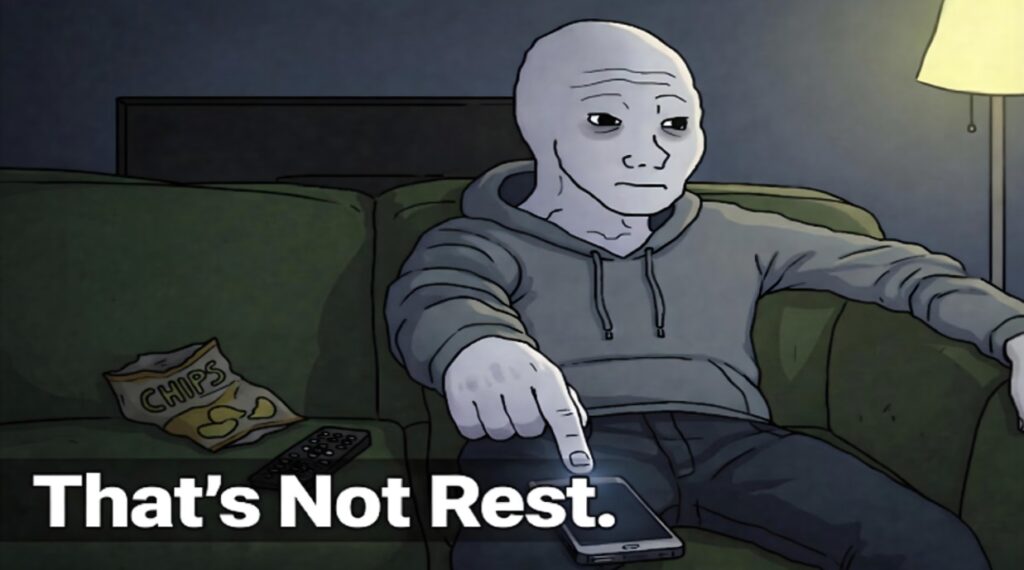
You did nothing today.
No work. No errands. No gym.
Just the couch, your phone, and a few hours of Netflix.
And somehow you feel worse than after a ten-hour shift.
By the end of this, you’ll know exactly why. And it has nothing to do with being lazy.
There’s a specific mechanism draining your energy all day. It runs in the background without any warning signs.
And most people never identify it because it doesn’t feel like work.
Here’s what’s actually happening.
Your brain doesn’t have unlimited energy. It runs on a finite cognitive budget every single day.
And that budget gets spent whether you’re in a meeting or flat on your couch.
Think about a typical Sunday. You wake up with nothing planned. You scroll Instagram for twenty minutes.
You can’t decide what to eat for breakfast. You flip between three shows before picking one.
You check your messages, put your phone down, and pick it up again.
You made dozens of small decisions before noon.
None of them felt like real decisions. That’s the whole trap.
Psychologists call this decision fatigue. Every choice you make pulls from the same mental resource pool.
Picking a breakfast option costs something. Choosing what to watch costs something.
Deciding whether to reply to a text costs something.
The research on this is consistent. Judges give harsher rulings late in the day.
Shoppers make worse choices the longer they stay in a store. The pattern holds across professions and income levels.
It’s not weakness. It’s just how the system is built.
Your brain is a battery. And micro-decisions drain it faster than nearly anything else.
But here’s the weird part.
You weren’t even making hard decisions. You were just scrolling.
And scrolling might be the most cognitively expensive thing you do all day.
When you open a feed, your brain isn’t resting. It’s evaluating. Every post triggers a rapid internal judgment.
Is this worth my attention? Do I agree with this? Does this make me feel behind?
You’re not watching passively. You’re running a constant low-grade evaluation engine.
Multiply that by several hundred posts in a single hour. Your brain processes thousands of small assessments before dinner.
Then it calls that a day off.
And here’s what most people miss. That evaluation isn’t neutral. Most of the content is emotionally loaded.
Bad news. Other people’s wins. Drama you didn’t ask for. Your brain flags all of it as potentially relevant.
That mild alertness never fully shuts down.
There’s a name for what builds up across all of this switching. Attention residue.
When you move between tasks, your attention doesn’t fully follow. Part of your focus stays locked on the last thing.
You close Instagram and open Netflix. But part of your bandwidth is still processing that post from three minutes ago.
Every switch costs you something. And on a passive day, you switch constantly.
Phone to TV.
TV to phone.
Phone to fridge.
Fridge to phone.
Stack enough of those and your brain is running twenty open tabs at once. Nothing fully loads. Nothing fully closes.
If this is clicking for you, hit like. It helps the algorithm show this to someone who needs it.
Now put the stress response on top of all of that.
Your nervous system doesn’t distinguish between a stressful video and an actual threat.
It responds the same way to both. Mild cortisol. A background hum of something being wrong.
Low-level alertness that doesn’t fully power down.
You’re not relaxing. You’re marinating in low-grade anxiety and calling it rest.
Think about what a full passive day actually adds up to.
Hundreds of micro-decisions made.
Thousands of posts evaluated.
Attention switched dozens of times.
Nervous system lightly activated for hours.
That’s not nothing. That’s a full cognitive workday with nothing to show for it.
Okay. Almost done. But this last part is the piece that changes what your next Sunday looks like.
The fix isn’t doing less. It’s doing something structurally different.
Your brain doesn’t recover from mental load by consuming nothing.
It recovers through low-stimulation activity with a clear beginning and end. Walking.
Cooking something from scratch. A real conversation with one person. Something where you know when you’re done.
These give your brain what passive scrolling never does. A concrete task. A natural stopping point.
No incoming stream of things to evaluate or react to.
The Sunday couch problem isn’t a character flaw. It’s the wrong kind of rest.
You wouldn’t fill a car with the wrong fuel and ask why the engine stays empty. Same principle applies here.
Let’s wrap this up.
Your brain runs on a limited daily budget.
Every micro-decision spends from it, including the trivial ones.
Scrolling is not passive. Your brain is evaluating the whole time.
Attention residue stacks up with every switch you make.
Emotionally loaded content keeps your nervous system lightly activated.
The wrong kind of rest depletes you more than actual work.
Recovery means low-stimulation, structured activity.
Not passive scrolling. Not passive watching. Something with a defined stopping point.
If this named something you’ve felt but couldn’t explain, share it with someone.
They’re probably too tired to figure it out on their own.
Watch on YouTube
