
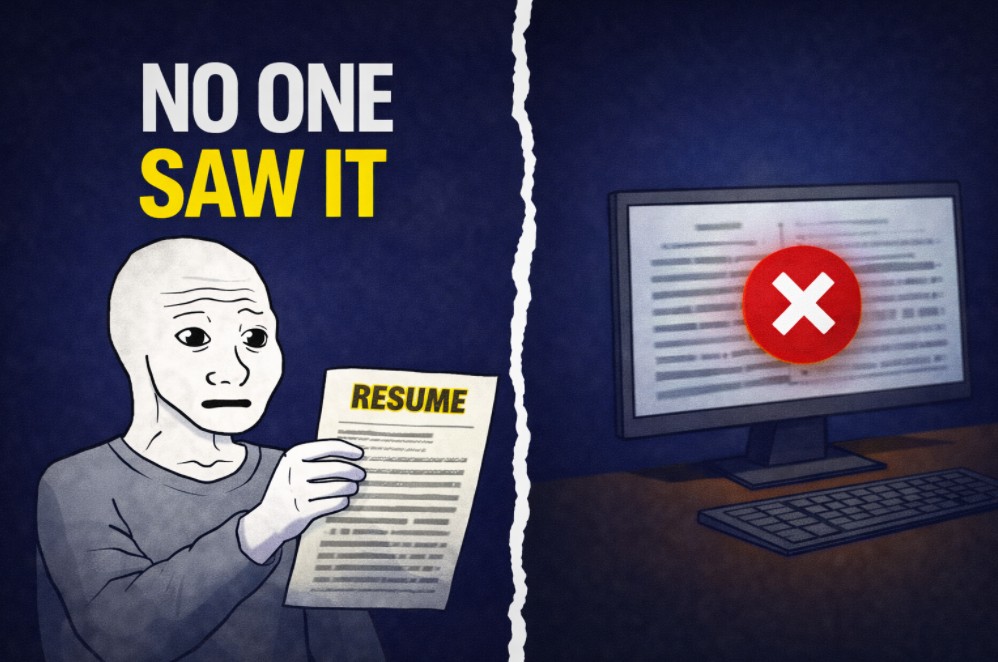
Nobody is rejecting your resume.
They’re not reading it at all.
By the end of this, you’ll know exactly why. And the reason has nothing to do with your qualifications.
Here is what is actually happening. Most companies above a certain size use filtering software to screen resumes automatically.
Before a human ever opens your file, that software scans it. It decides in seconds if you move forward.
If your resume fails that scan, it disappears. No email. No explanation. Just silence.
You did not get rejected. Your document got archived.
That is the problem. And it keeps happening to people who are genuinely qualified.
Let’s make it concrete.
Imagine you applied for a marketing coordinator role. You spent real time on your resume.
Two-column layout. Sidebar with skill icons. Color-coded section headers. It looks polished.
You are proud of it.
Here is what the software sees when it opens your file: a corrupted mess.
Most ATS software reads documents in a single stream. Left to right, top to bottom, one continuous flow.
It cannot process multiple columns. It cannot parse text boxes or icon graphics.
When it hits your two-column layout, it cannot separate them. Both columns get read simultaneously.
Your job titles mix with your sidebar skills. The output is jumbled and unreadable.
Your resume gets flagged. It is archived before a single person sees your name.
But here is what most people miss. The design problem is actually the smaller issue.
The bigger issue is your language.
Every job posting contains specific words. Not vague suggestions. Actual filter terms fed directly into the system.
When the posting says “cross-functional coordination” and “stakeholder communication,” those phrases become required matches.
Your resume needs to contain that exact language. Not similar language. Not synonyms. The exact phrasing.
You wrote “team collaboration” and “managed projects.”
Close. Not close enough.
The ATS does not read for meaning. It matches text strings. If the string is absent, you are filtered out.
You can be fully qualified. You can be the best candidate in the pool. If the words are not there, you are invisible.
Here is where it gets interesting. Let’s say your resume does clear the filters. A real human opens it.
Or more precisely, a real human glances at it.
Research on recruiter behavior shows a consistent pattern.
Hiring managers spend roughly six to eight seconds on initial resume review. Six seconds to decide whether to read further or move on.
In that window, they scan for three things.
Your most recent job title. One or two recognizable company names. And whether the layout makes that information immediately findable.
If they have to look for anything, they move on.
Back to the marketing coordinator application. The candidate who got through the ATS? One column.
Standard formatting. Keywords pulled directly from the posting. Not more qualified than you.
Just more readable than you.
That is the competition you are actually in.
If this is making sense, hit like. It sends a signal to the algorithm, same way keywords send a signal to ATS.
Now let’s fix it.
The format that passes ATS is not complicated.
One column. No tables. No text boxes. No icon grids. No graphics of any kind.
Use standard section headers.
The words “Experience,” “Education,” and “Skills.” Not “My Background” or “What I Bring.” ATS systems look for standard labels.
Anything creative gets misread or skipped entirely.
For file format: PDF is usually fine. But some older systems cannot parse PDFs correctly.
When the posting specifies a format, use it. When it does not, a clean Word document is the safer bet.
None of this is exciting. But it is the difference between being read and being archived.
Now, keywords.
Pull up the job posting. Read it twice.
Write down the specific phrases used for responsibilities and requirements.
Then use those phrases in your resume wherever they honestly describe your experience.
You are not copying. You are translating.
Your experience is real. The language just needs to match theirs. Do this for every application. Not once.
Every time. A generic resume sent to thirty companies is a resume nobody reads thirty times over.
Okay. Almost there. But the last part is where your actual response rate changes.
Your resume is not a record of what you did. It is an argument for why you should be hired.
Every bullet point should answer one question: why does this matter?
Most resumes describe duties. Duties are not arguments.
“Managed social media accounts” is a duty. “Grew Instagram engagement by forty percent in three months” is an argument.
Numbers. Outcomes. Specific impact. That is what makes a recruiter stop the six-second scan and actually read.
Back to the marketing coordinator. You fix the format. One column, no graphics, clean headers.
You match the keywords from the posting. You rewrite every bullet as a result, not a task.
You apply to the same thirty companies.
This time, eight of them call back.
Same person. Same experience. Different document.
Quick recap.
Most resumes are filtered by software before any human opens them.
ATS cannot read columns, text boxes, or graphics.
Keywords must match the exact language in the job posting.
Recruiters spend about six to eight seconds on the first pass.
Your resume is not a list of duties. It is an argument.
Format. Keywords. Results. Those are the three levers.
Fix those three, and you are not competing for attention anymore. You are just visible in a pool where most people quietly filtered themselves out.
If this helped, subscribe. The algorithm decides who sees this video the same way ATS decides who gets seen.
Give it the right signal.
Watch on YouTube
