
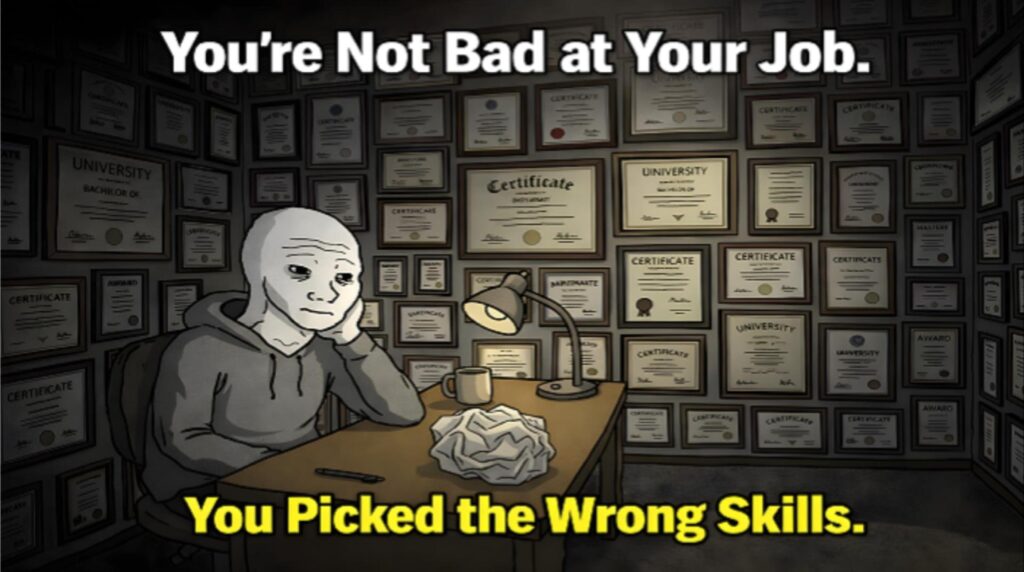
You’ve been picking skills based on what feels interesting.
That is the most expensive mistake you can make.
By the end of this, you’ll know exactly which skills actually move your income. There is a pattern. And it is not about working harder or longer.
Most people treat skill-building like a hobby. They pick what excites them. They ignore what the market is paying for.
Those two things are almost never the same list.
Every skill has a return on investment. Just like a financial asset. Some skills compound over time. Most plateau fast.
The gap between the two is not small.
Here is how most people end up on the wrong side.
Someone decides to learn video editing. Makes sense. Content is everywhere. Every business needs video.
So they spend a year on tutorials, buy a course, practice through weekends. Twelve months later they can edit.
Clean cuts, color grade, the full package.
But here’s the weird part.
Freelance rates for video editing have barely moved in years. Supply exploded. Every person with a laptop and spare time can edit now.
The market was flooded before most people even got started.
This is the first pattern. Skill value is not about difficulty. It is about supply and demand.
If a million people can do something, the pay reflects that. Even if it took you a year to get there.
So what actually determines skill value?
Three things.
Scarcity. How many people can do this right now? Not eventually. Right now.
Consequence. What breaks without it? If the answer is a minor delay, the pay is low. If the answer is the company loses money, the pay is high.
Adjacency. Does this skill make your other skills more valuable? Skills that multiply other skills are paid differently.
Skills that stand alone usually are not.
Think about it this way. A skill solves a problem. Two connected skills solve a system. Systems are worth more than problems.
Now back to the video editor.
They hit a ceiling. Rates are flat. They are now competing against editors in lower-cost cities charging half as much.
The effort was real. The skill is real. The market does not care about either of those things.
Here’s where it gets interesting.
The editors who are actually getting paid well are not the most technically skilled. They are the ones who edit and understand distribution.
Or who edit and manage the client relationship. Or edit and run ad strategy alongside it.
One skill has a price. Two connected skills have leverage.
This is the second pattern: skills multiply each other. They do not just add.
Learning a skill adjacent to your first does not double your value. In many cases it multiplies it by ten or more.
Because now you solve a complete problem. Not just one piece of it.
A designer who understands conversion. A developer who communicates clearly with non-technical teams.
A marketer who can read a spreadsheet. None of these combinations are rare. But they are paid as if they are.
The reason is simple. Complete problem-solvers are genuinely harder to find. The parts are common.
The combination is not.
If this is landing for you, drop a comment. And if you’ve hit an income ceiling you cannot explain, stay here.
The third pattern is where most people lose years of effort.
There is a difference between credentials and capabilities.
Credentials are what you list. Capabilities are what gets used.
Most people optimize for credentials. Finish the course. Get the certificate. Add it to LinkedIn. Then wonder why nothing changed.
Here is why it did not.
Clients and hiring managers do not pay for a certificate. They pay for confidence that the problem will get solved.
A track record of solved problems communicates that. A certificate communicates that you sat through something.
Most hiring decisions are made in under ten seconds. Certificates do not show up in those ten seconds. Work does.
The fix is not complicated. Build something real. Solve a problem for an actual person. Document it.
That one project does more than a shelf of certificates.
Okay. We are almost there. But this last part is the most important one.
Back to the video editor, one final time.
The ones who broke through the ceiling did not go learn an entirely different skill. They went one layer deeper.
They learned what their clients actually cared about.
Clients do not care about color grading. They care about whether the video gets views. They care about whether it drives sales.
The editor who started framing their work that way started charging that way too. The skill did not change.
The positioning did.
That is the third pattern. Skills positioned around outcomes get paid for outcomes.
Skills positioned around deliverables get paid for deliverables. These are very different paychecks.
Let’s pull it all together.
Skill value runs on three variables.
Scarcity. Consequence. Adjacency.
Low on all three means a fast plateau. High on even two means you compound.
Credentials do not pay. Demonstrated results do.
Positioning toward outcomes is not a soft skill. It is a pricing decision.
The video editor spent a year learning to edit. The ones who built real careers spent that same year learning who they edited for.
Pick your next skill the same way. Start with market demand. Check supply.
Check consequence. Then learn.
If this helped, hit like. The algorithm appreciates people who actually finish videos.
And subscribe, because the next one will change how you see your career.
Watch on YouTube
