
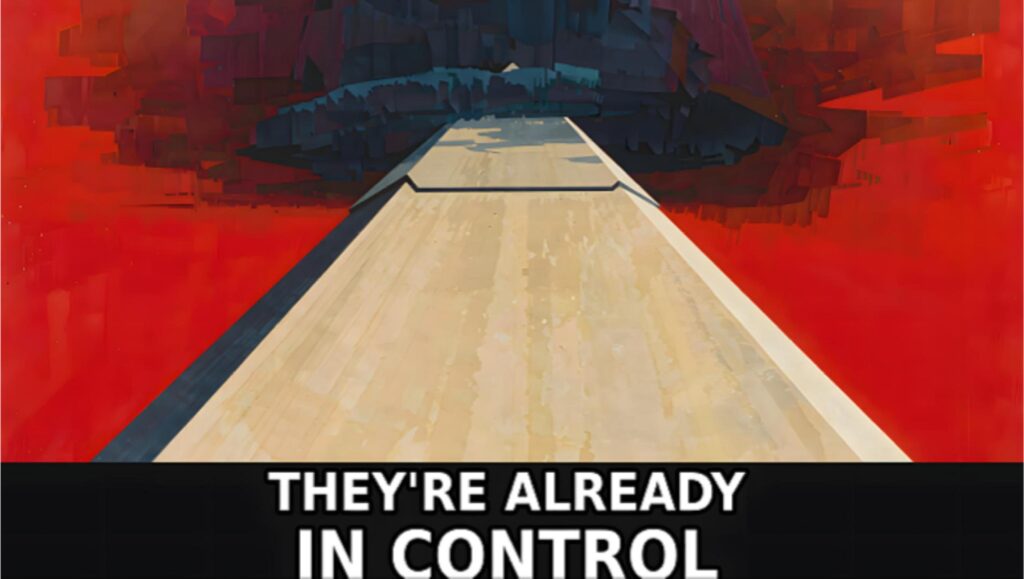
They’re Already In Control
What if the world was never taken from us?
What if we just… slowly handed it over?
We like to think power is obvious.
Governments. Presidents. Parliaments. Flags.
That’s what we’re taught to see.
That’s where we’re told authority lives.
But what if that’s no longer where the real decisions are made?
Because if you look closely… something has already changed.
Not suddenly. Not dramatically. Quietly.
The companies that build the machines now control production.
The systems that move money no longer need borders.
The platforms that connect people don’t belong to any one country.
And the infrastructure we rely on… is increasingly built, maintained, and optimized by private systems.
This didn’t happen through a coup.
No one declared it. No one voted on it.
It just… became more efficient.
And efficiency always wins.
We used to believe governments controlled the economy.
Now it’s harder to tell where one ends and the other begins.
Because when companies build the systems that everything depends on… they don’t just participate in the world.
They shape it.
And at some point… shaping the world starts to look a lot like running it.
But here’s where most people get it wrong.
This isn’t about corporations becoming villains.
This isn’t about some secret group taking over the planet.
That story is too simple. Too dramatic. Too easy to dismiss.
This is something else.
Because the companies at the center of this shift don’t need to conquer governments.
They just need to outgrow them.
Think about it.
If a network becomes essential enough… it doesn’t need permission.
If a system becomes global enough… it doesn’t need borders.
If a platform becomes central enough… it doesn’t need to replace anything.
Everything else just starts depending on it.
And dependence… is a quiet form of power.
So maybe what we’re seeing isn’t a takeover.
Maybe it’s a transition.
A transition from a world organized by nations… to a world organized by systems.
And those systems… are built and operated by corporations.
But even that isn’t the final form.
Because something else happens next.
At first, these companies compete.
Different technologies. Different standards. Different ecosystems.
But competition has a limit.
When systems become large enough… conflict becomes inefficient.
And when conflict becomes inefficient… coordination begins.
Not publicly. Not officially. But gradually.
Shared standards. Shared protocols. Shared infrastructure layers.
And over time… what used to be separate entities starts to behave like a network.
Not a single company. Not a single government.
Something closer to an alignment.
A layer that sits above everything else.
You could call it a cartel.
But that word feels too aggressive.
Because this isn’t just about control.
It’s about stability.
If the world depends on automated production, global digital finance, and interconnected infrastructure…
then instability becomes the greatest threat.
Not just for people. But for the systems themselves.
And systems that control enough value will always try to stabilize their environment.
That’s where everything connects.
Robots produce the value. Automation replaces labor. Human income becomes unstable.
So the system adapts.
Not by reversing automation. But by redesigning distribution.
Robot tax. Infrastructure expansion. Basic survival guarantees.
Not as charity. Not as ideology. As a requirement.
Because a system without consumers collapses.
So humans remain.
Not as workers. Not as producers. But as participants. As consumers. As stabilized elements inside a much larger structure.
And this is where the role of the state becomes… interesting.
Because something very specific happens.
The state doesn’t disappear.
It can’t.
But it also doesn’t operate the way it used to.
It becomes a frame. A boundary. A familiar shape. A story people still believe in.
Because people don’t live inside abstract systems.
They live inside identities.
Countries provide that.
Flags. Languages. Laws. Histories.
So the state remains.
Not as the primary operator of power. But as the interface.
The layer that connects people to the systems actually running the world.
From the outside, everything still looks the same.
Countries still exist. Elections still happen. Policies are still debated.
But underneath… something else is coordinating the structure.
Something that doesn’t need to announce itself.
Because it’s already embedded in everything.
And now we reach the question that matters.
If this system keeps expanding… what do the people at the very top actually want?
Because money stops being the point.
When you control production, infrastructure, and distribution…
what’s left to want?
Maybe the answer isn’t things.
Maybe the answer is time.
Not just longer life. That’s too simple.
Something harder to define.
Access.
Access to different forms of existence. Different layers of experience. Different relationships with memory, perception, continuity.
It doesn’t matter what the technology is.
Biology. Machines. Interfaces. Something we haven’t named yet.
The important part is this:
Not everyone gets access.
Because access… is the real currency now.
And that creates a separation.
Not just in wealth. Not just in power.
In reality itself.
Most people continue living inside the system.
Stable. Supported. Protected.
They don’t starve. They don’t collapse. They don’t fall out of society.
But they also don’t see beyond it.
And the people above that layer… don’t just live better.
They live… differently.
In ways that are difficult to explain. And even harder to question.
Because how do you demand access to something you don’t fully understand?
How do you resist a structure that keeps you comfortable?
How do you reject a system that removed most of your suffering?
And maybe that’s the final piece.
This doesn’t feel like oppression.
It feels like relief.
A softer world. A more stable life. A system that works.
And maybe that’s exactly why it lasts.
Because no one feels the need to fight it.
Maybe nothing was taken.
Maybe everything was optimized.
And maybe the only thing that changed… is where the real power lives.
We still see nations. We still talk about politics. We still believe in the structures we grew up with.
But underneath… the system has already shifted.
Not away from us. But around us.
And maybe we’re not outside of it.
Maybe we were always meant to be part of it.
Just not at the level we thought.
Maybe this is why.
Watch on YouTube
