
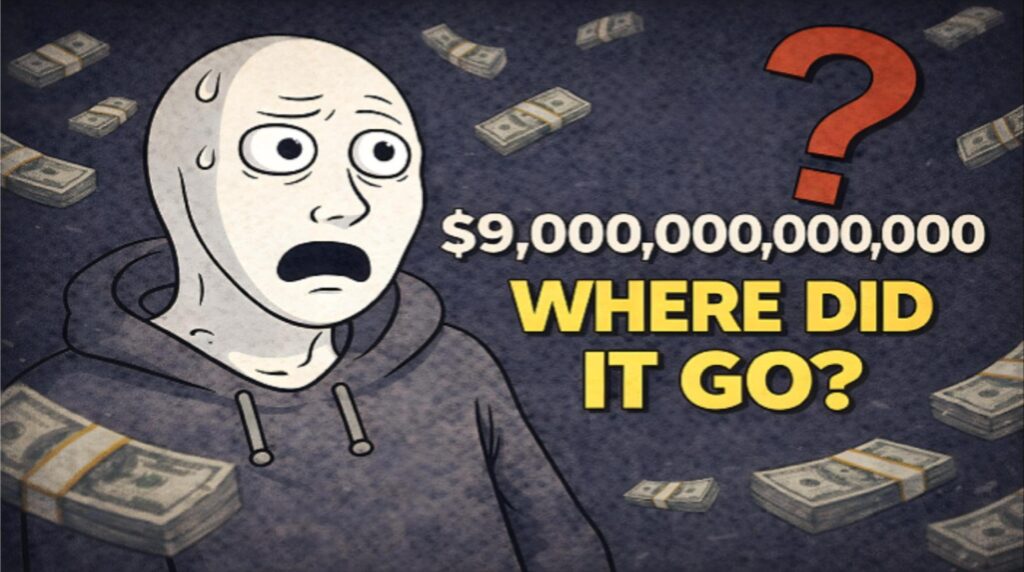
They printed trillions of dollars.
You got nothing.
By the end of this, you’ll understand exactly where it went. And it wasn’t an accident.
Here’s the thing. When a government “prints money,” it doesn’t mail you a check. It buys financial assets.
And if you don’t own financial assets, that money was never coming to you.
Let’s start with what quantitative easing actually is.
When the economy slows down, central banks like the Federal Reserve have a tool.
They create new money electronically and use it to buy bonds from banks and large financial institutions.
The banks get cash.
The bonds go to the central bank.
That’s it.
No new factories. No new jobs created directly. Just a large transfer of liquid money into the financial system.
The idea is that the banks, now flush with cash, will lend more. Businesses borrow. People borrow. The economy moves.
That’s the theory.
Here’s where it gets interesting.
In two thousand eight, the Fed used this tool for the first time at massive scale. They bought over one trillion dollars in assets in the first round alone. Stocks recovered.
Housing recovered. The economy technically stabilized.
But wages didn’t recover. Not at the same speed.
If you owned a house or a stock portfolio in two thousand eight, the next decade was very good to you.
If you were renting and living paycheck to paycheck, you mostly watched from the outside.
That gap didn’t happen by accident. It’s baked into the mechanism.
Here’s the core problem.
When new money enters the financial system, it doesn’t distribute evenly. It flows upward first.
Think of it like water dropped at the top of a mountain. It runs downhill. But the people living at the top of the mountain get wet immediately.
The people at the bottom might wait years. Or the water evaporates before it gets there.
Economists call this the Cantillon effect.
The people closest to the new money — banks, large investors, asset holders — benefit first and most.
By the time the effects trickle down to wages and consumer prices, the original advantage is gone.
The money moved. It just didn’t move to you.
So where did two thousand twenty’s trillions go?
In March two thousand twenty, the Fed launched the largest quantitative easing program in history.
Before the pandemic, the Fed’s balance sheet sat at around four trillion dollars.
By early two thousand twenty-two, it had nearly doubled — peaking at close to nine trillion.
At the same time, governments sent direct stimulus checks. One thousand two hundred dollars.
Then six hundred. Then one thousand four hundred.
You felt those.
That was fiscal policy. Government spending going directly into your account.
But the much larger number — the central bank’s balance sheet expansion — went into bonds, mortgage-backed securities, and corporate debt.
That money made stocks go up.
The S and P five hundred dropped thirty four percent in February two thousand twenty.
By August of the same year, it had fully recovered.
Then it kept going up.
If you had money in the market, your portfolio recovered before the pandemic was even close to over.
If you had no investments and were just trying to pay rent, you got your twelve hundred dollars and watched asset prices climb out of reach.
Drop a comment if this is starting to make sense — or if it’s making you a little angry.
Now here’s the part nobody talks about.
This isn’t just about rich people getting richer. It’s about what happens to prices afterward.
When you flood the financial system with money, eventually some of it does reach the real economy. It takes time. But it gets there.
And when it does, there’s more money chasing roughly the same amount of goods and services.
Prices go up.
That’s inflation.
So the sequence runs like this. New money gets created. It flows into assets first. Asset owners get wealthier.
Then, years later, prices start rising for everyone. Including people who never benefited from the asset boom in the first place.
You didn’t get the upside.
You got the downside.
Okay. We’re almost at the end. But this last part is the most important.
Is there an alternative?
Some economists argue yes. Instead of buying bonds from banks, central banks could in theory send money directly to households.
Some call this helicopter money. Others call it a digital currency distribution.
It’s been debated. It hasn’t been implemented at scale.
Why not?
Partly because it’s politically complicated. Partly because central banks are structurally designed to work through the financial system, not around it.
And partly because the people making those decisions tend to be the people closest to the top of the mountain.
That’s not a conspiracy theory.
That’s just how institutions work.
Let’s wrap this up fast.
Quantitative easing means central banks create money and buy financial assets.
The goal is to stabilize the economy and encourage lending.
The money enters through banks and large institutions, not through your paycheck.
Asset prices go up first. Wages go up later. Sometimes much later.
The Cantillon effect means people closest to the new money benefit the most.
You probably felt the inflation but missed the asset boom.
Stimulus checks were different — that was direct. That you felt.
The balance sheet expansion? That went into the market.
And the market isn’t equally owned.
The top ten percent of Americans own roughly eighty nine percent of all stocks.
So when you ask why trillions were printed and you felt nothing — that’s why.
If this helped it click, hit like. The algorithm runs on attention, not on central bank money. Unfortunately.
Watch on YouTube
