
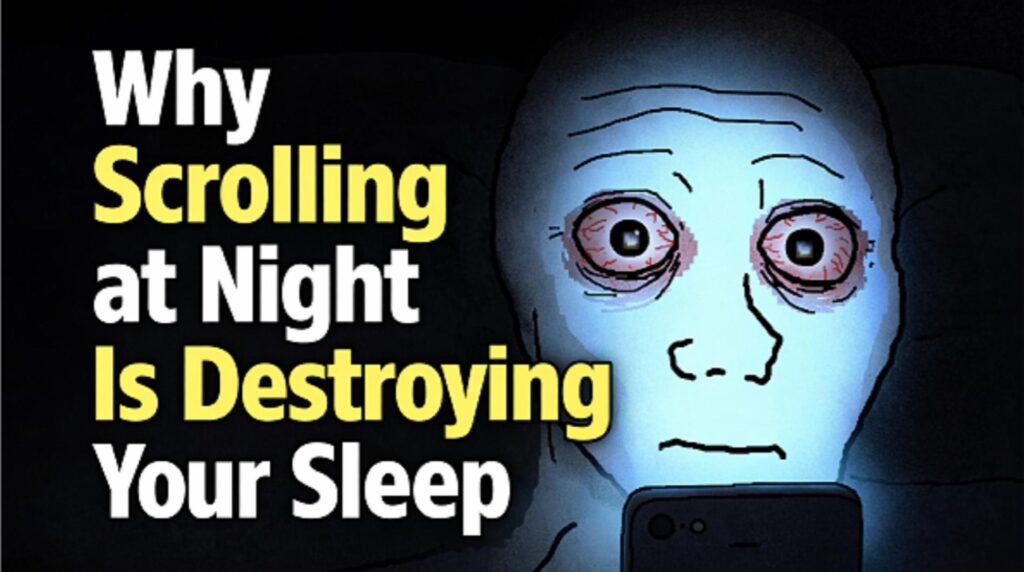
Scrolling at Night Is Destroying Your Sleep — and you probably already know it’s bad.
But knowing hasn’t stopped you. So let’s talk about why.
Your body runs on a clock. A literal biological clock called your circadian rhythm.
It controls when you feel awake, when you feel tired, and when your body repairs itself.
And for most of human history, that clock was synced to one thing: sunlight.
When the sun went down, your brain started producing melatonin. Melatonin is not a sleeping pill.
It’s more like a signal. A message from your brain saying: okay, it’s dark, wind down, sleep is coming.
Your body temperature dropped. Your heart rate slowed. You got drowsy. The whole system worked.
Then we invented electric light. Then screens. Then smartphones.
And we handed our brains a device that blasts short-wavelength blue light directly into our eyes at 11pm.
Here’s the problem.
Your brain cannot tell the difference between blue light from your phone and blue light from the sun.
To your circadian clock, they look identical. So when you’re lying in bed scrolling at midnight, your brain thinks it’s midday.
Melatonin production slows down. Your sleep signal gets suppressed.
And your body doesn’t start winding down — it stays alert.
You’re not tired because it’s late. You’re tired because you’ve been awake too long.
Those are different things. And your phone is actively blocking the signal that’s supposed to bridge that gap.
Okay. Now here’s where it gets worse.
It’s not just the light.
The content you’re consuming at night is doing its own damage.
Social media, news, short videos — all of it is designed to produce dopamine.
Small hits, fast, one after another. Your brain is not winding down when you scroll.
It’s activating. Every notification, every new post, every surprise is a tiny dopamine spike.
Your nervous system is in a low-grade alert state. Not panicked. Just… on.
Think about what you actually need to fall asleep. Your brain needs to slow down. Heart rate drops.
Cortisol falls. Thoughts get less urgent. Now compare that to what scrolling does.
New input every three seconds. Mild emotional reactions. Comparison, curiosity, low-level stress.
These two states are opposites. You cannot do both at the same time.
So you lie there.
Phone down.
Eyes closed.
And your brain is still running.
Still processing.
Still half-expecting the next notification.
You’re physically in bed, but mentally you’re still online.
That gap between lying down and actually falling asleep?
That’s not normal.
That’s called sleep onset latency, and for a lot of people it’s gotten longer every year.
Here’s something most people don’t know. Sleep isn’t just about quantity.
It’s about timing and architecture.
Your sleep happens in cycles. Each cycle is roughly 90 minutes.
Inside each cycle you move through lighter sleep, deep slow-wave sleep, and REM sleep.
REM is where your brain consolidates memory, processes emotion, and does the kind of repair work you can’t get any other way.
The best REM sleep happens in the second half of the night — roughly from 3am onwards, depending on when you sleep.
When you delay your sleep onset by two hours because you were scrolling, you’re not just losing two hours.
You’re cutting off the end of your sleep architecture.
You’re skipping the REM cycles your brain was saving for the back end.
And no amount of sleeping in on Saturday fully compensates for that.
Your brain keeps score. You don’t.
Now. What actually fixes this.
Option one is simple and most people hate it. No screens for the last hour before sleep.
That’s it.
Put the phone in another room. Let your melatonin do its job. Your brain will start winding down.
You’ll fall asleep faster. You’ll sleep deeper.
You will feel the difference within three days. This is not bro wellness advice.
This is just removing the thing that’s blocking a process your body already knows how to do.
Option two is a dimmer version of option one. Blue light blocking glasses.
Night mode on your phone. These reduce the light signal without eliminating it.
They help. They’re not as good as no screen. But they’re real.
Option three — and this is the one nobody wants to hear — is dealing with why you’re scrolling in the first place.
For a lot of people, late-night scrolling isn’t really about entertainment.
It’s about avoidance. It’s easier to scroll than to lie in the dark with your thoughts.
Easier than facing tomorrow. Easier than the mild anxiety that shows up when the stimulation stops.
If that’s what’s happening, the phone isn’t the root problem. It’s just the symptom that’s easiest to see.
Let’s recap.
Your body has a biological clock that runs on light signals.
Blue light from your phone tells your brain it’s daytime. This suppresses melatonin and delays sleep.
The content you scroll activates your dopamine system and keeps your brain alert.
Delayed sleep cuts off the back half of your sleep architecture — specifically REM cycles.
REM loss affects memory, mood, and cognitive performance.
Sleep onset latency — the time it takes to fall asleep — gets longer the more you scroll.
Removing screens 60 minutes before bed is the highest-impact fix available.
Blue light filters help but don’t fully solve it.
And if you’re using your phone to avoid your own thoughts, that’s a different problem — but the solution still starts with putting the phone down.
You already knew screens were bad for sleep. Now you know exactly why.
So tonight, when you’re lying there at midnight convincing yourself you’ll put it down after one more video — you’ll know what’s actually happening in your brain.
Put the phone down.
If this helped, subscribe.
We make one video a week. No fluff. Just the stuff you were never taught.
Watch on YouTube
