
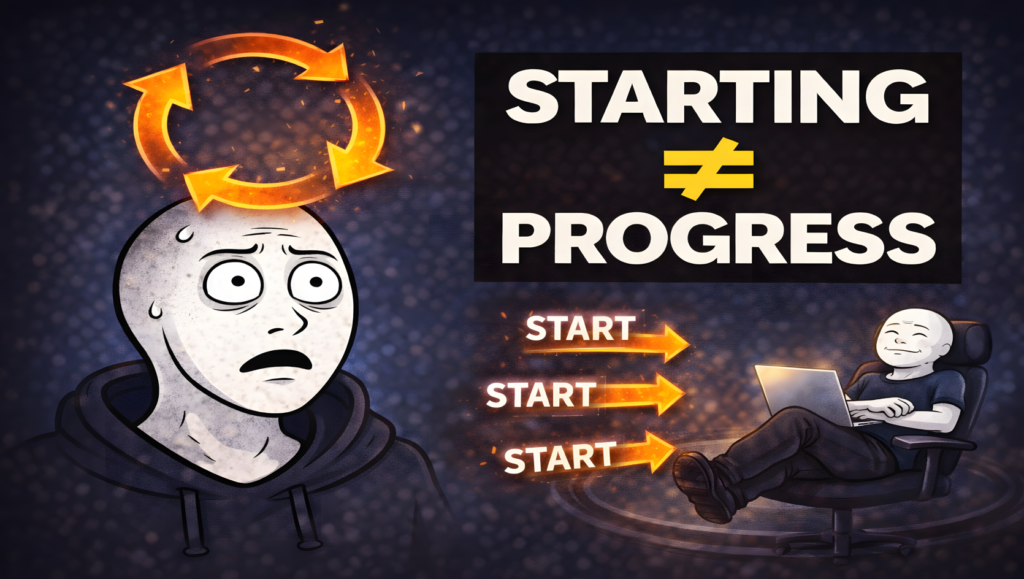
You start a new habit on Monday.
By Thursday it’s gone. So you wait for next Monday to start again.
By the end of this, you’ll understand exactly why starting feels better than continuing.
And why that feeling is quietly keeping you stuck.
Here’s what’s actually happening when you hit reset.
Every time you start something new, your brain gets a small reward.
A sense of possibility. A clean slate. No failure attached yet. No disappointing progress.
Just the version of yourself who is absolutely going to follow through this time.
That feeling is real. And your brain learns to chase it.
The problem is continuing doesn’t feel like that.
Continuing means facing where you actually are. The missed days. The slower progress than you expected.
The gap between who you are right now and who you imagined you’d be by now.
Starting erases that gap temporarily. So the brain trades real progress for the feeling of progress.
Here’s the concept behind this. Researchers call it the fresh start effect.
Certain moments feel like natural reset points. Monday. January first. After a birthday.
After a breakup. These moments create a psychological partition between your past self and your future self.
The past self failed. The future self won’t.
The reset feels clean because it lets you file the failure under a different identity. That wasn’t the real you.
The real you starts now.
Here’s where it gets interesting. This effect isn’t random. It’s intentional.
The fresh start effect was designed to be motivating. For many people it works exactly once. They start.
They build momentum. They follow through.
But for people who restart repeatedly, something else is happening. The reset has become the reward.
Not the work. Not the results. The reset itself.
Every new Monday, new journal, new app, new system delivers the dopamine hit that finishing never will.
Because finishing requires tolerating the messy middle. The part where progress is invisible.
The part where you’re not sure it’s working.
The part where the only thing keeping you going is the decision you made before you had any evidence it was worth it.
If this is clicking, hit like. The algorithm rewards people who make it past Thursday.
Now here’s the part that makes it worse. Restarting has a hidden cost most people don’t notice.
Every time you reset, you don’t start from zero. You start from below zero.
Because every restart teaches your brain a quiet lesson. You are someone who restarts.
Not someone who continues. That identity hardens with every cycle.
And eventually the brain stops expecting you to follow through at all.
This is why it gets harder over time. Not because the habit is harder. Because the evidence against you has been accumulating for months.
Okay. We’re almost at the part where this becomes useful. The last piece is the most actionable.
So if restarting is the trap, what actually breaks the cycle?
The research on habit continuity points to one shift above everything else. Stop optimizing for starting.
Start optimizing for surviving the worst day.
The best day is easy. You’re motivated. The conditions are right.
The worst day is the one that determines whether the habit survives.
Most people design their habits for their best self. Ambitious targets. Full routines. All or nothing.
That design guarantees failure on any day that isn’t perfect.
The alternative is designing for your worst self. What is the smallest version of this habit you could do on a terrible day?
Two minutes. One rep. One sentence. Something so small it can’t be skipped.
Because a bad day done is worth more than a perfect week reset.
The moment you survive a bad day without resetting, you change the evidence.
You are now someone who continued. And that identity compounds the same way the restart identity did.
Just in the opposite direction.
So let’s recap.
Starting feels better than continuing because it delivers a clean slate and a sense of possibility.
The fresh start effect creates a psychological partition between a failed past self and a hopeful future self.
When restarting becomes the reward itself, the work never gets done.
Every restart teaches your brain you are someone who restarts. That identity hardens over time.
The fix is not better motivation. It is designing for your worst day, not your best.
Surviving one bad day without resetting changes the evidence. And the new identity starts building from there.
Next time you feel the pull to start over, do this instead. Find the smallest possible version of the thing.
Do that. Don’t reset.
And if you’re already planning to start fresh on Monday, I understand.
But now you know exactly what’s happening.
Drop a comment if you’ve restarted the same habit more than three times. I want to know what it was.
Watch on YouTube
