
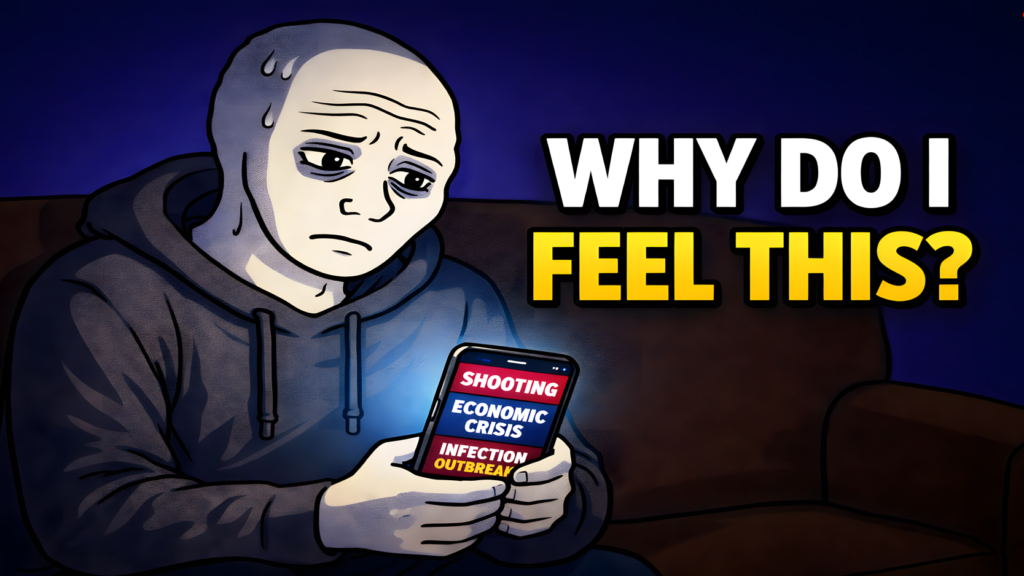
You’ve been watching the news to stay informed.
But you already know something is off.
You watch more and understand less.
By the end of this, you’ll know exactly why.
And it’s not because you’re not paying attention.
It’s because of how news is built.
There’s a term called negativity bias.
Your brain is wired to register bad news faster than good news.
News organizations know this. They use it.
Here’s the mechanism.
When you see a threatening headline, your amygdala fires.
That’s the part of your brain that handles fear and urgency.
It doesn’t distinguish between a tiger and a tweet.
Both get the same alarm response.
Think about the last time you doom-scrolled through headlines for twenty minutes.
You didn’t feel calm after.
You felt wired. Anxious. Vaguely angry.
Nothing specific. Just a baseline tension you carried for the next hour.
That’s not the news informing you. That’s your amygdala stuck in loop mode.
But here’s where it gets worse.
The volume of news you consume doesn’t equal understanding.
Research on information overload consistently shows that more input past a certain point reduces
your ability to form coherent judgments.
You think you know more. You actually know less of the right things.
Imagine you read twelve different articles about the same economic policy.
Four say it will create jobs. Four say it will destroy jobs. Four say nobody knows.
You close your laptop. What do you actually know?
You know there’s disagreement. That’s it.
But you feel informed. That feeling is the trap.
Now here’s the part most people miss.
News is not designed to give you understanding. It’s designed to give you updates.
Those are different things.
An update tells you something happened.
Understanding tells you why it happened, what it means, and what comes next.
Most news stops at the first one.
If something feels like it matters, you spend the next hour reading ten more articles about it.
Every article gives you a slightly different update.
None of them give you the full picture.
Because that would require context. Context takes time to build. Time is the one thing the news
cycle doesn’t have.
If this is making sense, hit like. The algorithm needs the signal.
Let’s go back to negativity bias. Because it has a second effect people don’t talk about.
It doesn’t just pull your attention toward bad news.
It also distorts your model of the world.
When you consume a steady diet of crises, conflicts, and disasters, your brain starts treating that as
the baseline.
Normal begins to look dangerous. Calm starts to feel like the exception.
Studies on perceived personal risk show that heavy news consumers consistently overestimate the
likelihood of crime, disease, and economic collapse in their own lives. Not because those things are
more common. Because those things are more covered.
Okay. We’re almost there. But the last part changes how you think about this completely.
The real cost of news isn’t the time you spend watching it.
It’s the mental residue it leaves behind.
Every anxious headline you processed today is sitting somewhere in your working memory.
That’s cognitive load. And cognitive load competes with everything else you’re trying to think about.
Decisions. Focus. Creative work. Clear thinking.
You don’t become more informed by consuming more news.
You become more informed by consuming better information less often.
One long-form article on a topic beats fifteen headlines about the same topic.
Slowing down your input actually improves your output.
That’s the reframe. Not less information. Better information.
So here’s what we covered.
Your brain responds to negative headlines with a fear response.
That fear response doesn’t make you smarter. It makes you more reactive.
More input doesn’t equal more understanding. It often means less.
News is designed to update you, not to inform you.
Heavy news consumption warps your perception of how dangerous the world actually is.
And the mental residue from anxious headlines reduces your ability to think clearly.
The fix isn’t to stop caring. It’s to consume with intention.
If this changed how you think about your news habits, subscribe.
Next time your phone pulls you to a breaking news alert, you’ll know exactly what’s happening in your brain.
And that’s the whole point.
Watch on YouTube
