
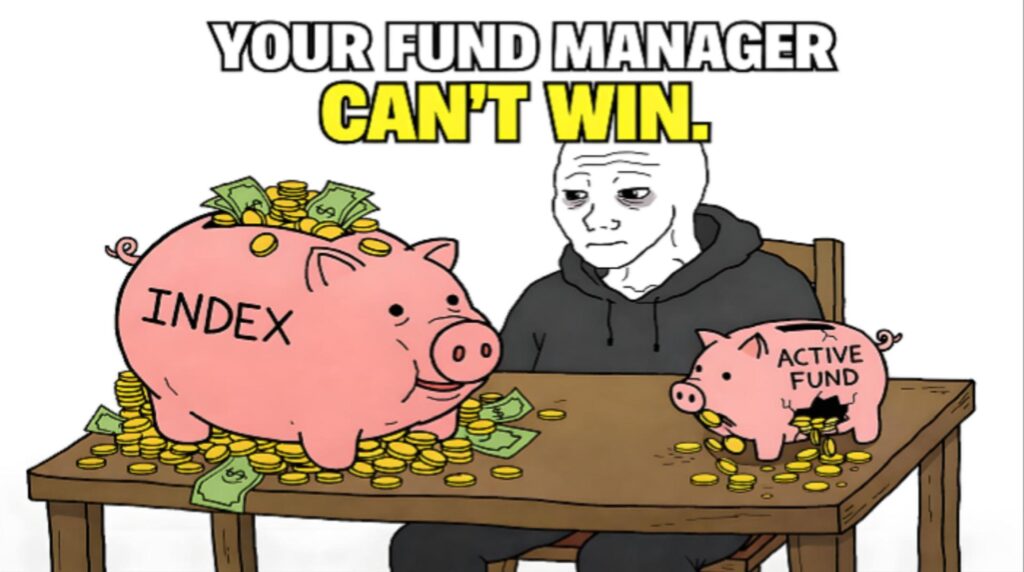
Most professional investors cannot beat a simple index fund.
And they know it.
By the end of this, you’ll understand exactly why. The answer isn’t about skill.
It’s a math problem built into the system. And nobody in finance is rushing to explain it to you.
Here’s the setup. You have two options.
Option one: hand your money to a professional fund manager.
He has an MBA, a research team, and access to data you’ll never see.
Option two: buy a fund that just copies the entire market. No manager. No strategy. Just owns everything automatically.
That second option beats most professionals. Over ten years. Over twenty. Consistently. Here’s why.
Let’s start with what an index fund actually is.
An index fund tracks a market index. The most common one is the S and P five hundred.
That’s the five hundred largest publicly traded companies in the United States.
When you buy one, you own a small piece of all five hundred at once. Apple. Microsoft.
Amazon. Everything. You don’t choose which ones. You own the whole basket.
But here’s what makes this interesting. The fund rebalances automatically when the index changes.
No human makes that call. There’s no research team involved. No annual bonuses pushing the wrong decisions.
The fund just mirrors the market.
The S and P five hundred has averaged roughly ten percent per year historically.
That’s the benchmark most active managers are trying to beat. Boring is cheap to run.
Cheap means low fees. Low fees are the first reason this strategy works.
Now picture the other option. An actively managed mutual fund. A real manager picks stocks for you.
He reads earnings reports, flies to conferences, and makes trades every day.
He also charges a fee. Usually between one and two percent of your total investment per year.
That sounds like nothing. Here’s what it actually does.
Say you and a friend both invest ten thousand dollars. You pick the index fund. She picks the active fund.
Both earn eight percent per year before fees. The index fund charges zero point zero five percent per year.
The active fund charges one point five percent per year.
After thirty years, your account holds roughly one hundred thousand dollars.
Her account holds roughly sixty-six thousand. Same start. Same market return.
Different fee. Thirty-four thousand dollars erased. Not from bad trades. From fees alone.
These numbers are based on standard compound growth at realistic fee rates. The math is not on the active fund’s side.
That’s the first problem.
The second problem is worse.
S and P Global publishes a report called the SPIVA Scorecard every year.
It compares active fund performance against index benchmarks across markets and time periods.
The numbers are consistent. The majority of actively managed funds underperform their benchmark index over ten years.
Over fifteen years, the gap widens further.
Here’s the weird part.
A fund that beats the market this year will likely rank average next year.
The track record of consistent outperformers is extremely thin.
And here’s something nobody talks about. Every year, a few funds beat the index by a wide margin.
Those funds get press coverage. The ones that quietly underperformed get closed or merged into other funds.
That’s survivorship bias. The data only shows you the winners. The full picture is worse.
Past performance doesn’t predict future performance.
That line is printed in the legal documents of every fund you’ve ever been sold. Almost nobody reads it.
If this is making sense so far, hit like. It helps more people find this.
So why can’t smart professionals consistently win?
Because the market is everyone.
Every professional investor, every algorithm, every hedge fund is acting on all available information.
All at the same time. When a company releases earnings, thousands of participants respond within seconds.
By the time a manager reads the report, the price has already adjusted.
This is market efficiency. Not that markets are always right.
That markets are extremely difficult to consistently outsmart.
Every smart participant is already in the game. You’re competing against all of them at once.
Your friend’s fund manager faces the same problem. He isn’t playing against random retail investors.
He’s playing against every institution simultaneously. After covering his own fees.
That’s a nearly impossible game to win consistently.
This doesn’t mean the market is perfectly efficient.
It means the margin for consistent outperformance, after fees, is razor thin.
Thin enough that most professionals can’t find it.
Okay. We’re almost there. This last part is where it all clicks together.
Most active funds lose to the index after fees. The few that win rarely repeat it.
The math points in one direction. Low-cost index funds. Held for a long time.
With consistent contributions.
You don’t need to find the right manager. You don’t need to time the market. You need time in the market.
Think back to you and your friend. Same starting amount. Same market return. The only difference was fees.
Now scale that over a full investing career. The gap between your account and hers doesn’t stop at thirty-four thousand.
It keeps growing every single year.
You don’t need to be a finance expert. Pick a low-cost index fund. Set up automatic contributions.
Leave it alone.
The boring choice won. And it didn’t even have to try.
Let’s recap.
An index fund owns the whole market automatically.
Active funds charge fees to try to beat it.
Most active funds underperform the market after fees over ten or more years.
The ones that outperform rarely repeat it.
Survivorship bias hides how many funds quietly fail.
The market is hard to beat because every smart investor is already in it.
Fees compounded over thirty years erase tens of thousands of dollars.
You don’t need the right stock. You don’t need the right manager. You need time, consistency, and low costs.
The most boring investment strategy is one of the most effective ever documented.
If this changed how you think about investing, subscribe.
And if you’re still putting money into an actively managed fund, drop a comment.
Let’s talk about it.
Watch on YouTube
