
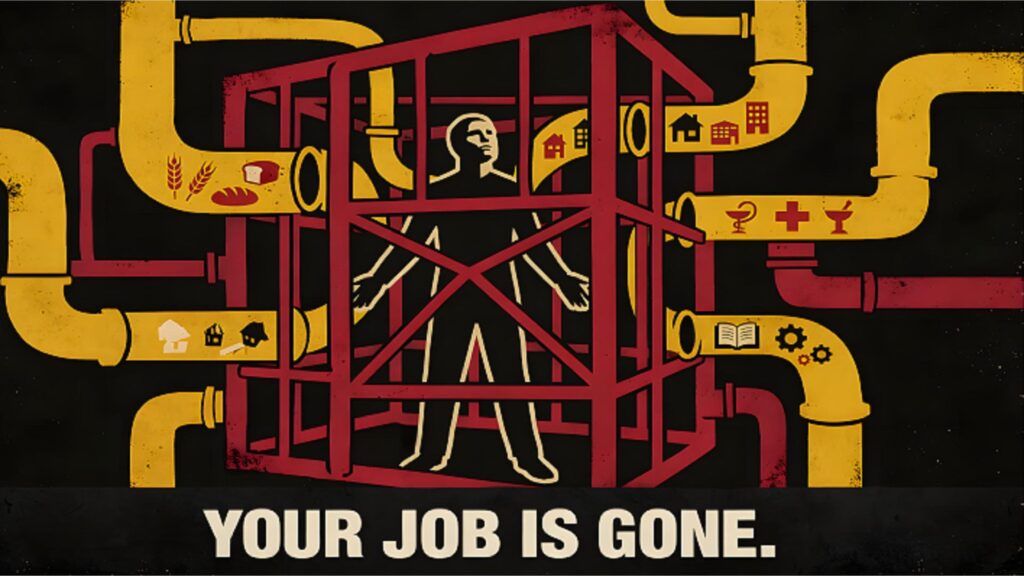
Your Job Is Gone.
Maybe the end of work… isn’t the end of the world.
Maybe it’s just the end of the world as we designed it.
For centuries, the system ran on one assumption.
Humans work. Humans get paid. Humans spend. Governments take a cut. And civilization keeps moving.
Simple. Elegant. Brutal.
And almost everything built on top of it.
Your rent. Your pension. Your hospital. The road outside your window. The school your child sits in.
All of it — somewhere underneath — resting on human labor.
Now imagine that layer starts disappearing.
Not all at once. That’s not how history works.
It starts where labor is repetitive. Measurable. Expensive.
Assembly lines. Warehouses. Long-distance transport. Agricultural harvesting. Security patrols. Construction support.
A robot doesn’t get tired. It doesn’t unionize. It doesn’t ask for weekends. It doesn’t need healthcare. It doesn’t retire.
And once the machine gets good enough… the logic becomes very simple.
Why pay a human forever for something a machine can do cheaper?
That logic doesn’t need ideology.
It only needs spreadsheets.
And spreadsheets don’t feel guilty.
So the labor market changes. Fast.
And something very old begins to break.
Not just jobs.
The meaning of work itself.
Because work was never just money.
Work was dignity. Structure. Identity. Belonging.
Work was the answer to a very basic question:
Why do I deserve to exist inside this system?
If millions of people can no longer answer that through labor… the system doesn’t just have an economic problem.
It has a legitimacy problem.
And this is where most people expect governments to step in.
I don’t think that’s how it happens.
Not first.
I think the first serious move comes from somewhere else.
From the winners.
Because the companies making the most money from automation eventually face a strange contradiction.
At first, replacing workers looks like pure upside.
Lower costs. Higher output. Better margins.
Beautiful.
Until they remember something obvious.
If enough people lose income… who buys the products?
If communities lose work… who maintains social order?
If governments lose tax revenue… who keeps the roads, the courts, the ports, the grids running?
And if the public starts seeing automation not as progress, but as theft… what happens to the companies leading it?
That’s when the smartest person in the room realizes something.
The future can’t be sold as replacement.
It has to be sold as transition.
And transition needs a price.
Not charity. Not guilt. Structure.
So imagine a company leader — maybe in manufacturing, maybe in mobility — standing in front of a government and saying something that sounds radical:
Tax us.
Not the old way. Not payroll taxes. Not labor-linked penalties.
Tax the robotic productivity itself. Tax the profit machines now generate at scale.
Call it a robot tax.
It sounds insane at first.
Why would a capitalist ask to be taxed?
Because maybe they’re not asking to lose money.
Maybe they’re asking to buy stability.
Think about the arithmetic.
A fully automated company removes enormous labor costs.
No payroll burden. No training churn. No human fatigue. No downtime in the old sense.
Margins expand dramatically.
So even if the state claims forty, fifty, sixty percent of machine-generated profit… the company may still be richer than any labor-based model ever allowed.
Why?
Because the total pool became so much bigger.
And because once robot tax becomes the central funding mechanism… other taxes shrink.
Payroll taxes fall. Compliance burdens vanish. Social conflict becomes manageable. Consumer demand stabilizes. People can still live.
The company doesn’t lose by paying robot tax.
The company helps redesign the rules of society around its own business model.
That is not altruism.
That is strategy.
Now the political part begins.
Because an idea from a business leader means nothing until someone turns it into a story the public can believe.
Some politician takes the robot tax proposal and reframes it.
Not as protection for capital. But as protection for people.
Not as a new deal between machines and corporations. But as a new social contract.
And the language changes.
“If robots take the jobs, robots should fund society.”
That line spreads instantly.
Simple. Fair. Emotionally satisfying.
And maybe that’s enough.
Maybe that’s all history ever needs.
Not perfect truth.
Just a good enough story attached to a useful system.
Then one country makes it work.
That’s the key moment.
Not theory. Example.
One country builds a robot tax framework tied directly to basic survival.
Not luxury. Not utopia.
Housing support. Healthcare access. Education. Food security. Digital connectivity.
Enough to ensure that losing your job doesn’t mean losing your right to exist.
And the results are hard to ignore.
Social unrest goes down. Consumption stabilizes. Political violence cools. Local economies adapt.
The model travels.
Other governments study it. Other companies support it. Other populations demand it.
And robot tax stops sounding radical.
It starts sounding inevitable.
Normal.
Like something that was always going to happen.
But here’s where it gets interesting.
Because once you accept robot tax… you’re not just changing fiscal policy.
You’re changing what citizenship means.
You’re admitting something profound:
Human survival is no longer tied to human labor.
That is not a small shift.
For most of human history, the right to live was tangled up with the ability to produce.
You hunted. You farmed. You built. You fought. You earned your place.
But if machines do the work, and machine profits fund the social base… that equation dissolves.
You no longer live because you worked.
You live because the system decided you should remain inside it.
That sounds humane.
Maybe it is.
But it also sounds… different.
Because once survival is guaranteed through system design rather than labor… another question appears.
What exactly is a human being now?
Consumer? Citizen? Beneficiary? Managed participant?
I’m not asking that as an accusation.
I’m asking because I genuinely don’t know.
And I think that uncertainty… is the real emotional center of this future.
People hear a story like this and jump to extremes.
Either this is utopia — no more meaningless labor, finally free.
Or this is dystopia — we become useless pets of the elite.
I don’t think either is fully true.
I think the real future is more uncomfortable than that.
Better in some ways. Worse in others. Safer, but stranger. Kinder, but more artificial. More stable, but more managed.
And maybe that’s exactly why it works.
Because total utopias don’t survive reality. And total dystopias don’t survive human complexity.
People are messy. Politics is messy. Technology is messy.
The future that actually arrives is usually a compromise between what is efficient and what humans can emotionally tolerate.
Robot tax might be that compromise.
Not paradise. Not slavery.
A negotiated system that keeps civilization from breaking while quietly redefining what it means to belong to it.
And the strangest part?
The people pushing it hardest may not be activists or philosophers.
They may be entrepreneurs.
The very people who destroyed the old labor system might become the architects of the first stable post-labor world.
History loves that kind of irony.
The factory owner becomes the designer of welfare. The automation company becomes the financer of public life. The machine economy becomes the thing that keeps humans fed, housed, and treated.
Not because the system became moral.
Because it became interdependent.
And that’s why humans don’t simply get discarded.
They get repositioned.
Less desperation. Less physical exhaustion. Less dependence on degrading work just to survive. More guaranteed infrastructure. More social floor.
That sounds good.
Maybe it is good.
But I can’t shake one thought.
If the system feeds you, houses you, treats you, transports you, educates you, sustains you…
then what exactly can you still say no to?
Maybe robot tax doesn’t just save the unemployed.
Maybe it introduces the first model of a civilization where human life is guaranteed… but also quietly integrated, measured, stabilized, and maintained by structures far larger than any individual.
A world where nobody starves.
A world where fewer people are abandoned.
A world where the old brutality of labor fades.
And yet…
a world where freedom becomes harder to define.
So maybe the question isn’t whether robot tax is good or bad.
Maybe the real question is:
When work disappears, and survival becomes infrastructure… will we feel liberated?
Or will we simply feel safe enough not to ask what changed?
I don’t know.
But if money becomes digital, and labor becomes robotic, and society starts being funded by the machines that replaced us—
then maybe robot tax isn’t just a policy.
Maybe it’s the first admission that the human world has already entered a new contract with power.
And maybe this is why the future won’t look like collapse.
It’ll look like relief.
At first.
Then one day, much later, we may look around… and realize something strange.
We were never saved from the system.
We were just given a softer place inside it.
Maybe that’s enough.
Maybe it isn’t.
Maybe this is why.
Watch on YouTube
