
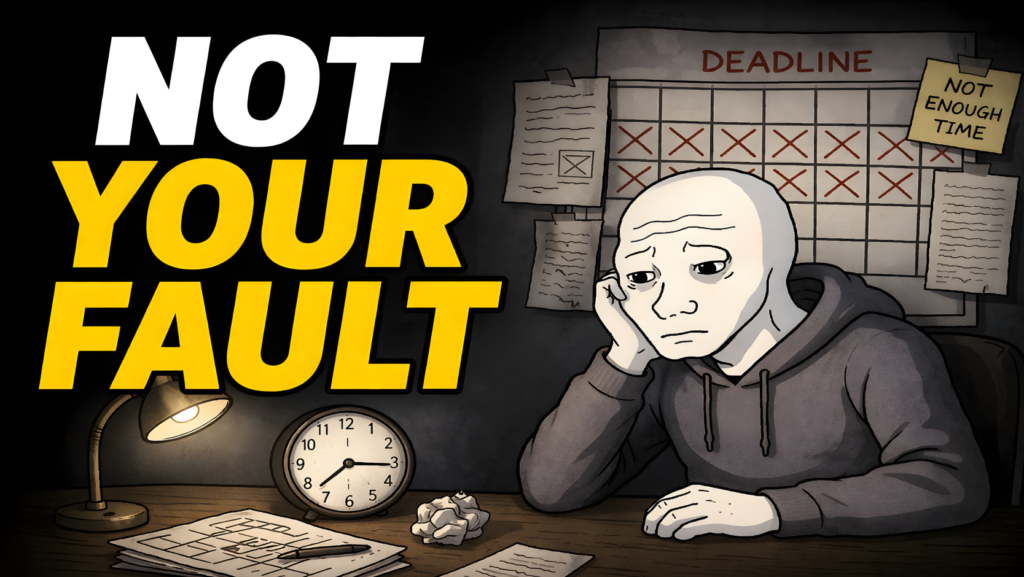
You thought it would take a week.
It’s been three months.
By the end of this, you’ll understand exactly why that happens every single time.
It’s not because you’re disorganized. It’s not because you’re lazy.
There’s a specific flaw in how your brain estimates time, and once you see it, you can’t unsee it.
It’s called the planning fallacy. Psychologists first identified it in the nineteen seventies.
Humans are systematically, predictably bad at estimating how long things take.
And the smarter you are, the worse the effect gets.
Here’s how it starts.
You decide to set up your home office. Simple enough. Move the desk. Run some cables.
Maybe hang a shelf. Saturday afternoon. Done by dinner.
Saturday arrives. You move the desk and realize the outlet is behind it. You need an extension cord.
The one you have is too short. You order a longer one online. It arrives Tuesday.
By then, you’ve half-dismantled a bookshelf that was also in the way.
There’s a pile of books on your bedroom floor. Three weeks later, you are still eating takeout at a folding table.
This is the planning fallacy in action.
The first reason it happens is something called the inside view.
When you plan a project, your brain focuses almost entirely on the task in front of you.
The steps you can see. The things you expect to happen.
It is working from your imagination, not from your history.
What it ignores is everything that has ever gone wrong before. Every project that ran over time.
Every obstacle that appeared from nowhere.
Your brain treats each new plan as if it exists in a perfect, frictionless world. It’s not naivety. It’s just the default setting.
But here’s the weird part.
If you asked a friend how long your type of project usually takes, they’d give a more accurate estimate.
They’d think about how these things always run longer. They’d factor in delays and distractions.
That’s called the outside view. And it’s almost always more accurate. Your brain just doesn’t use it when you’re the one planning.
Researchers asked university students to estimate how long it would take to finish their thesis.
Each student gave two estimates. An optimistic one and a realistic one.
Even the realistic estimate was off by weeks. Almost none of them finished on time.
The realistic estimate wasn’t realistic. It was just a slightly less optimistic version of the same inside view.
And here’s the kicker. Knowing about the planning fallacy doesn’t protect you from it.
Kahneman himself, the psychologist who helped identify it, estimated his book would take one year to finish.
It took nine.
Back to the home office.
If you had known that similar projects tend to take four times longer than estimated, you could have planned around that.
But you were thinking about your project, not projects like yours. That’s the trap.
Drop a comment if this has happened to you. Because it has happened to everyone.
The second reason is the unpacking problem.
When you imagine finishing something, your brain jumps to the end state. The clean desk.
The finished product. What it skips is the chain of sub-tasks that actually gets you there.
Every task contains hidden tasks. Ordering a cable sounds like one step.
But it’s also researching which cable, finding a retailer, waiting for delivery, realizing you ordered the wrong one, returning it, and reordering.
Each step you imagined was actually five steps you didn’t.
When researchers asked people to estimate how long a task would take step by step, the estimate was significantly longer than estimating the task as a whole.
And it was significantly more accurate. Breaking it down forces your brain to see what it was skipping.
Okay. We’re almost there. But the last part is the most important.
There is one more force keeping you in the same loop every time. The belief that this project is different.
Your other projects ran long, sure, but this one is simple.
You know exactly what to do. You’ve done similar things before. This time is straightforward.
This is the unique project illusion.
Every project feels unique from the inside because you’re imagining your specific steps and your specific knowledge.
But from the outside, it looks exactly like every other project that ran over time.
The uniqueness is in your head. The delays are in reality.
So what actually works.
First, use the outside view deliberately.
Before you estimate, ask what the typical completion time is for this type of project.
Not your project. Projects like yours. Find one real reference point. Then double it.
Second, unpack aggressively. Break the project down until you hit actual physical actions.
Not “set up the office.” List every cable, every trip, every step that has to happen in sequence.
The estimate only becomes accurate when the sub-tasks are visible.
Third, build in buffer by default. Not as a pessimism tax. As a structural expectation.
Things will go sideways. That is not a planning failure. That is just how projects work.
Here’s the rapid version. Your brain has a planning fallacy.
It uses the inside view and ignores your own history. It sees the end state but skips the sub-tasks.
It thinks this project is the exception. Knowing about the fallacy doesn’t fix it.
The outside view is almost always more accurate. Unpacking reveals hidden steps.
Buffer isn’t pessimism. It’s calibration.
Next time you think something will take a week, ask someone who’s done it before.
They’ll tell you something you didn’t want to hear. And they’ll be right.
If this made sense, hit like. The algorithm takes longer than expected to figure things out too.
Turns out it also has a planning problem.
Watch on YouTube
