
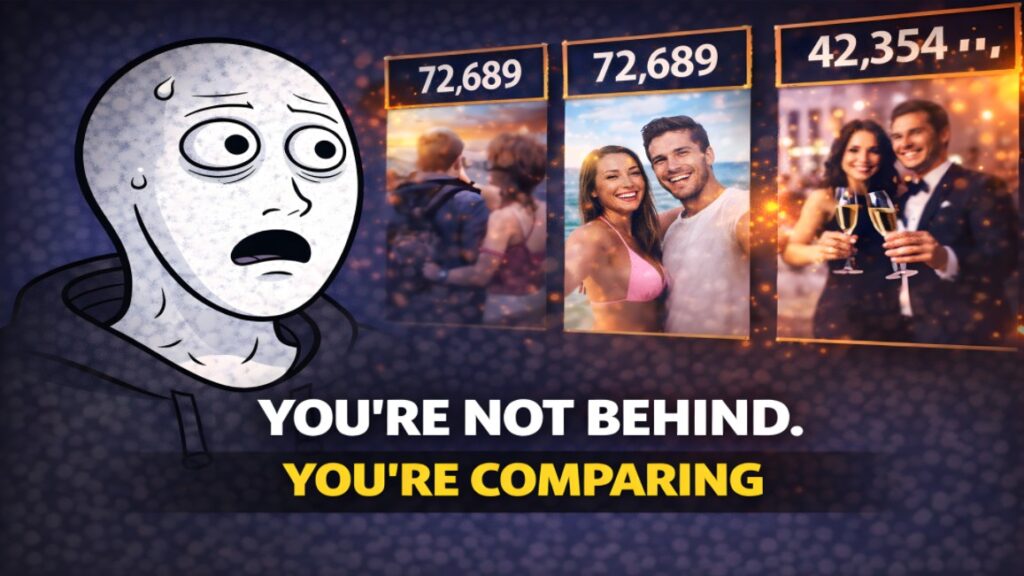
You’re not behind.
You just keep looking at the wrong scoreboard.
By the end of this, you’ll understand exactly why you feel like everyone else is winning.
And why that feeling is mathematically designed to deceive you.
Here’s the thing. Your brain is running a comparison engine.
It never stops. Every time you open your phone, it scans for data. Who got a promotion. Who bought a car.
Who moved into their own place. And then it ranks you against all of them.
The problem is the data is garbage.
Social media is not a census.
It’s a highlight reel. Nobody posts the Tuesday where they ate cereal for dinner and watched TV for four hours.
They post the vacation. The job offer. The engagement. You’re comparing your entire life to everyone else’s best moments.
That’s not a fair fight. That’s not even a fight. That’s you losing a game that was rigged before you started.
Here’s where it gets interesting.
There’s a concept called survivorship bias. During World War Two, engineers studied bullet holes on planes that returned from combat.
They almost reinforced those areas. But a statistician named Abraham Wald pointed out the problem.
The planes with holes in other spots didn’t come back. You’re only seeing the survivors.
Your feed works the same way. You only see the people who have something worth posting.
The ones grinding quietly, struggling, figuring it out — they’re invisible. You never factor them into your comparison.
So your sample is completely skewed.
You think everyone your age has it figured out. They don’t. You’re just not seeing the ones who don’t.
Drop a comment if you’ve felt this. Because the next part is going to make a lot of sense.
Now let’s talk about timelines.
School conditions you to believe life runs on a fixed schedule. Finish this grade, move to the next.
Everyone the same age, hitting the same milestones, at the same time. For eighteen years that’s how it works.
Then it stops.
And suddenly people are on completely different paths.
Someone starts a business at twenty-two. Someone else figures out their career at thirty-one. Someone gets married early.
Someone doesn’t want to. The synchronized schedule is gone. But your brain didn’t get that memo.
It’s still grading you on the school model. Same age, same milestone, same time. Except that model doesn’t exist anymore.
Here’s the weird part.
The people you think are ahead?
Most of them are operating on debt, parental support, or luck they’re not advertising.
The guy with the new car might be paying for it for the next six years.
The person with the apartment might have a co-signer.
The one with the job title might hate every single day of it.
You’re not seeing the cost. You’re only seeing the output.
Okay. We’re almost at the part where this all clicks. Stay with it.
Let’s talk about what comparison actually costs you.
Every hour you spend measuring yourself against someone else is an hour you’re not building anything.
It’s not neutral. It has a price. Researchers call this the social comparison effect.
When people constantly benchmark themselves against others, motivation drops. Not because they get lazy.
Because the goal keeps moving. Someone is always further ahead. The finish line never arrives.
It’s the same dopamine trap as your phone. One more scroll.
One more comparison. One more reason to feel like you’re falling behind.
The exit is not pretending other people don’t exist. The exit is changing the scoreboard.
Compare yourself to who you were six months ago. That’s the only data set that’s actually about you.
Did you learn something? Did you earn more? Did you handle something better? That’s a fair measurement.
Everything else is noise.
Your timeline is not late. It’s just yours.
Let’s run it back fast.
Your brain runs a comparison engine every time you open your phone.
Social media is a highlight reel, not a census.
Survivorship bias means you only see the people winning, never the ones struggling.
School trained you to expect a synchronized timeline. That timeline ended at graduation.
Most people who look ahead are carrying costs you’re not seeing.
Constant comparison kills motivation because the goal never stops moving.
The only useful comparison is you versus six months ago.
You’re not behind. You’re just measuring wrong.
If this hit, subscribe. The algorithm rewards good taste.
Watch on YouTube
