
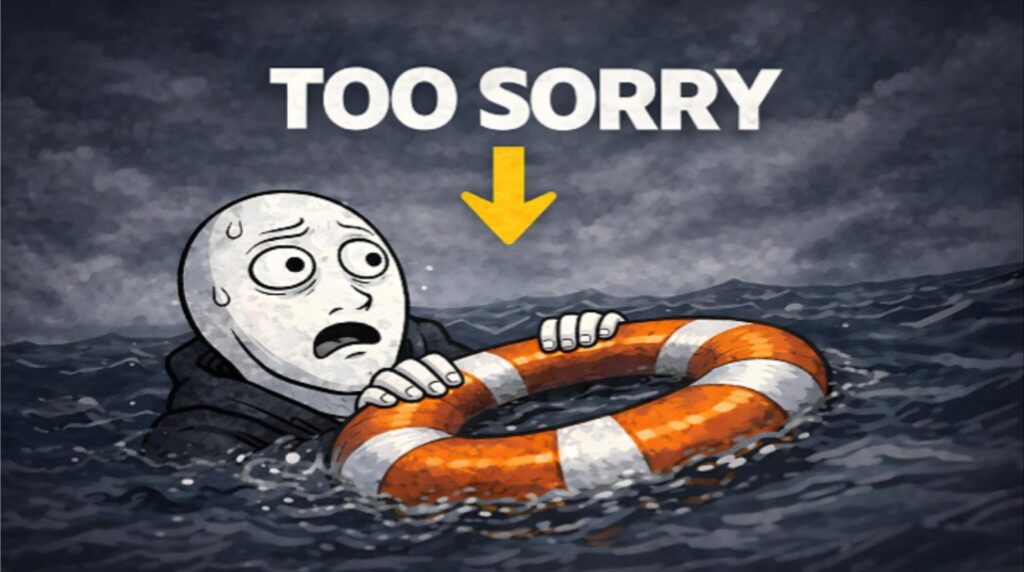
The more you apologize, the less people trust you.
That sounds backwards. It isn’t.
By the end of this, you’ll understand why apologies have a threshold.
Past that threshold, they stop being a sign of respect.
They become a signal of something else entirely.
This isn’t about being rude or never admitting fault.
It’s about what your brain broadcasts when you apologize for things that don’t require an apology.
That broadcast has a cost.
An apology is a social transaction.
When you apologize for a genuine mistake, it signals two things.
First: you understood what went wrong.
Second: you have enough self-awareness to acknowledge it.
Both of those are competence signals.
They build trust.
But here’s where it breaks.
When you apologize for things that aren’t mistakes, something different happens.
You apologize for asking a question.
For taking up space in a conversation.
For sending an email that needed to be sent.
Now the signal flips.
Instead of showing self-awareness, you’re showing uncertainty about whether you should exist in the situation at all.
That’s not a competence signal.
That’s the opposite.
Think about currency.
When a government prints too much money, each bill buys less.
The same thing happens with apologies.
Every unnecessary sorry you say devalues the ones that matter.
If you apologize fifteen times a day, the person on the receiving end stops reading them as genuine.
They become filler.
Like saying ‘um’ before every sentence.
Here’s where it gets interesting.
The people who apologize most are often the people who mean it most.
They’re not performing.
They genuinely feel bad about things.
But the mechanism doesn’t care about intention.
Frequency erodes meaning regardless of sincerity.
If this is hitting close to home, hit like. It helps more people find this.
There’s a second layer here.
When you over-apologize, you’re not just diluting meaning.
You’re broadcasting a model of yourself.
Every unnecessary apology says: I’m not sure I belong here.
I’m not sure my time is worth yours.
I’m not sure my presence is justified.
People pick up on that.
Not consciously, most of the time.
But they update their mental model of you.
The running example: a meeting.
Someone walks in two minutes late.
They say sorry four times, explain the traffic, apologize again, and then apologize for explaining.
Versus someone who walks in two minutes late, says one clean sorry, and sits down.
Both were equally late.
But your read of their confidence is completely different.
Okay. We’re almost at the part that changes how you actually behave.
This is the part people get wrong.
Removing apologies doesn’t mean replacing them with silence.
It means replacing them with the thing the apology was trying to do.
Apologies serve two functions.
One: acknowledging a real mistake.
Two: managing social friction.
Function one you keep.
Function two you replace.
Instead of ‘sorry for the late response,’ try ‘thanks for your patience.’
Instead of ‘sorry to bother you,’ try ‘quick question.’
Instead of ‘sorry, this might be a stupid question,’ just ask the question.
You’re not being less considerate.
You’re shifting from signaling weakness to signaling respect.
The message to the other person changes completely.
From ‘I’m not sure I should be talking to you’ to ‘I value your time and I’m using it well.’
Same social goal. Completely different broadcast.
Over-apologizing usually starts early.
For a lot of people, it was a survival strategy.
In environments where conflict was unpredictable, apologizing preemptively kept things calm.
It worked.
So the brain filed it under: this is how you stay safe in social situations.
The problem is that strategy doesn’t transfer well to adult professional contexts.
In those environments, preemptive apologies don’t read as peacekeeping.
They read as low self-assessment.
Changing it feels uncomfortable because you’re unlearning a reflex that was once functional.
Not because you’re doing something wrong.
Back to the meeting.
The person who walked in late and apologized once.
They probably felt the urge to apologize four more times.
They just didn’t.
That gap between the urge and the action is where the recalibration happens.
So here’s what we covered.
Apologies are competence signals when they’re attached to real mistakes.
When they’re not, they signal uncertainty about your own legitimacy.
Apology inflation is real.
Frequency destroys meaning regardless of how sincere you are.
Every unnecessary sorry broadcasts a model of yourself that works against you.
You don’t replace apologies with silence.
You replace the function they were serving.
Acknowledge real mistakes. Replace friction management with something stronger.
Over-apologizing often started as a useful strategy.
It just doesn’t scale into contexts where confidence is the signal people are reading.
And the fix isn’t faking confidence.
It’s recognizing that the apology was never really about the other person.
It was about managing your own discomfort.
If this explained a habit you’ve had for years and couldn’t name, subscribe.
We make these so you understand the mechanism, not just the symptom.
Watch on YouTube
