
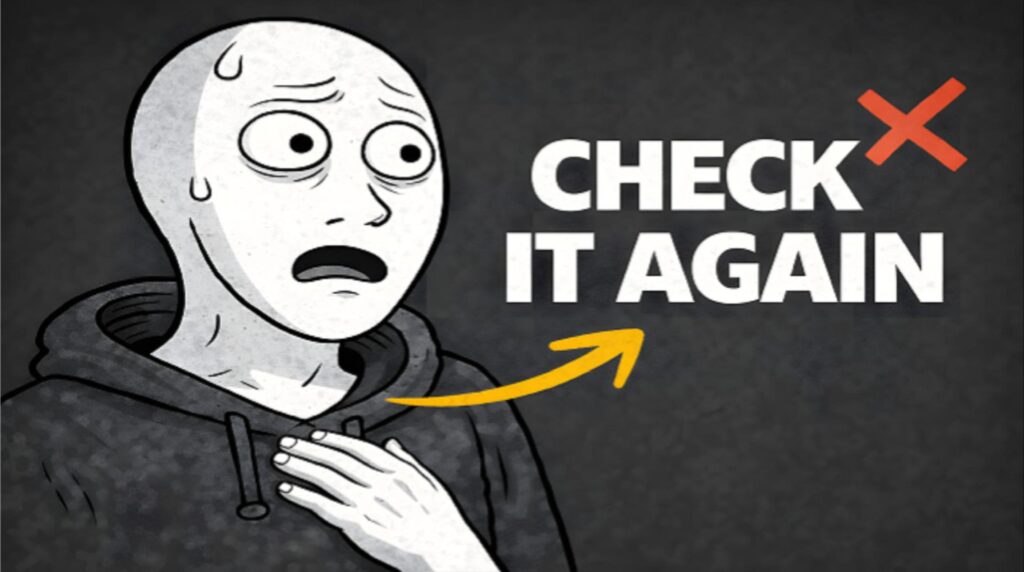
You locked the door. You know you did.
So why are you already back at the handle?
By the end of this, you’ll know exactly why your brain refuses to trust itself.
And it has nothing to do with memory.
It’s a loop your brain builds on purpose.
This is called intolerance of uncertainty.
Your brain treats an unverified lock the same way it treats an actual threat.
That’s where the checking starts.
Here’s what’s actually happening.
Your brain has a threat-detection system.
It scans for unresolved risk.
When something feels uncertain, it flags it.
Not because the risk is real.
Because the risk is unconfirmed.
That’s a very different thing.
The lock probably worked. You’ve locked that door a thousand times.
But your brain doesn’t care about probability.
It cares about closure.
No confirmation means the loop stays open.
And an open loop feels like a threat.
Here’s where it gets strange.
You go back and check the door. It’s locked.
For about four seconds, you feel better.
Then the doubt comes back.
Why?
Because you checked it in a low-attention state.
You were thinking about something else.
Your brain didn’t record the moment properly.
So the check doesn’t count.
This is the core problem.
The more you check, the less each check satisfies.
You’re not solving the uncertainty.
You’re teaching your brain that uncertainty requires checking.
Every check trains the loop tighter.
Not everyone does this equally.
People with higher intolerance of uncertainty get louder signals from that threat system.
The brain rings the alarm faster.
The discomfort of not knowing is physically stronger.
This isn’t a character flaw.
It’s a calibration issue.
Think of it like a smoke alarm that triggers on toast.
The alarm is working fine.
The sensitivity is just set too high.
If this is making sense, hit like. The algorithm actually uses that signal.
The same trait that makes you check the lock also makes you double-check your work.
Verify your emails before sending.
Plan for problems nobody else thought of.
The mechanism isn’t broken.
The threshold is off.
Let’s use one example all the way through.
You leave for work. Lock the door. Walk to your car.
Halfway there, the thought hits.
Did I lock it?
You go back. You check. It’s locked.
You walk to your car again.
By the time you reach it, the doubt is back.
So you go back again.
This is not a memory problem.
You remember locking it.
But the memory doesn’t feel certain enough.
And your brain needs certainty, not memory.
The second check doesn’t give you more certainty.
It just delays the next doubt by a few minutes.
Okay. We’re almost there. The last part is the most important.
Checking more doesn’t help.
Neither does trying harder to remember.
What actually works is tolerating the uncertainty instead of resolving it.
This sounds wrong. But here’s the logic.
Every time you go back to check, you confirm to your brain that the uncertainty was worth acting on.
You reinforce the loop.
The alternative is to leave without checking.
Not because you’re sure.
Because you’re willing to be unsure.
That single action tells your brain the uncertainty is survivable.
Over time, the signal gets quieter.
This is the same principle behind exposure-based approaches used in behavioral therapy.
Not thinking your way out.
Acting your way out.
Back to the door.
You walk to your car.
The doubt comes.
You don’t go back.
That moment is the training.
So here’s what we covered.
Your brain has a threat system that flags unresolved uncertainty.
Uncertain doesn’t mean dangerous.
It just means unconfirmed.
Checking feels like it solves the problem.
It doesn’t.
It trains the loop to run again.
The checking habit gets stronger with every check.
Not weaker.
Some brains have a higher sensitivity to uncertainty.
That same sensitivity drives careful, thorough behavior in other areas.
The mechanism isn’t the problem.
The threshold is.
And the way to lower the threshold isn’t more checking.
It’s choosing not to check.
If this explained something you’ve been living with for years, subscribe.
We make these so you stop blaming yourself for how your brain works.
Watch on YouTube
