
You will spend forty dollars on a friend’s birthday dinner without blinking.
But you will talk yourself out of a thirty dollar book you actually want.
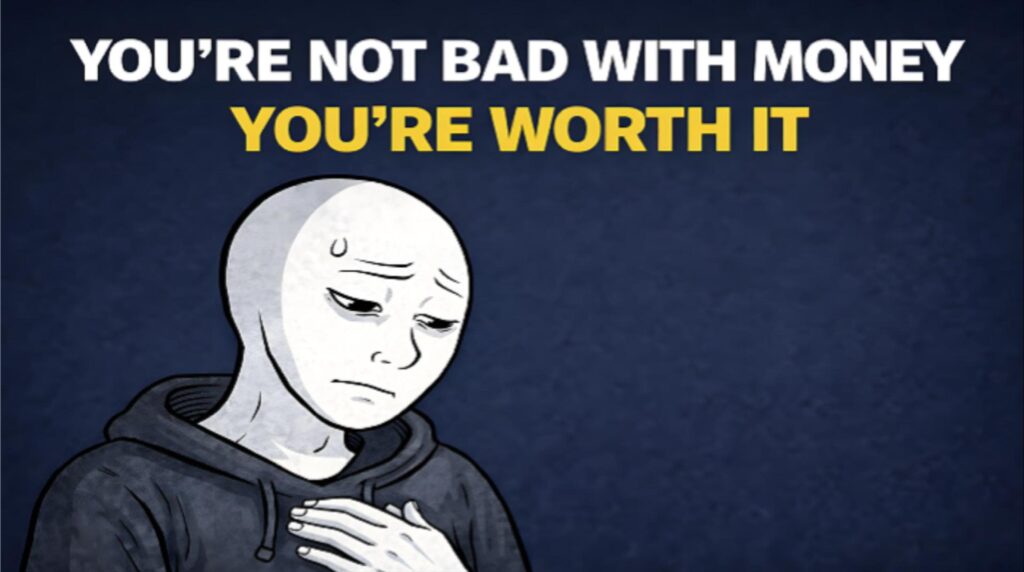
By the end of this, you’ll understand the exact mental block that makes spending on yourself feel wrong —
even when you can afford it.
And it’s not generosity. It’s not modesty.
It’s a specific psychological mechanism that’s been quietly running in the background your entire adult life.
Here’s the part that’s going to bother you:
the same brain that calculates every penny you spend on yourself gives other people’s purchases a free pass.
Think about the last time you bought something for someone else.
You probably did not spend thirty minutes justifying it. You saw what they would like. You bought it. Done.
Now think about the last time you bought something significant for yourself. How long did you sit on it?
This is called the justification gap. When you spend on others, the social value is obvious and immediate.
You get to be the good friend, the thoughtful partner, the generous colleague. That is a real psychological reward.
When you spend on yourself, there is no external validation.
There is just you, staring at a price tag, trying to figure out if you deserve it.
And that word is doing a lot of work. Deserve.
Here’s where it gets interesting:
your brain is not asking whether you can afford it. It is asking whether you have earned it.
Most people carry an invisible tax on spending money on themselves.
Every personal purchase comes with a mental surcharge. Did I work hard enough this week?
Have I been productive enough? Am I allowed to enjoy this right now?
Nobody imposes this tax on you from the outside. You built it yourself.
Piece by piece, from years of messages telling you that self-spending is indulgent,
that treating yourself is something you earn, not something you just do.
The irony is that you apply this tax selectively. You buy coffee every morning without a second thought.
Streaming subscriptions, food delivery, spontaneous online orders — these slip through because they are small or habitual.
But a jacket you actually love? A course you genuinely want? A weekend trip by yourself?
Suddenly the tax kicks in. And it is not proportional to the price. It is proportional to how personal the item feels.
The more it is about you — your comfort, your enjoyment, your growth — the heavier the tax.
Here is why spending on others feels so clean.
When you buy something for someone else, you get immediate social feedback.
A thank you. A reaction. A visible sign that your spending was worthwhile.
Researchers call this prosocial spending, and it is one of the most reliable ways to produce a short-term happiness boost.
The feedback loop is tight. You spend. They respond. You feel good. Done.
Self-spending has no feedback loop. You buy the thing. You go home. You sit with it.
There is no external signal telling you the purchase was correct.
So your brain, which is always hunting for confirmation, does not know what to do with it.
And in the absence of external approval, it defaults to doubt.
This is why you return things you bought for yourself at a much higher rate than gifts.
Not because the item was wrong. Because the approval never came.
Drop a comment if you have ever returned something you genuinely wanted —
not because it was the wrong size, but because you just felt weird about it.
There is a specific version of this that is worth naming.
A lot of people cannot spend money on enjoyment unless they feel they have been productive first.
Worked out, checked off the to-do list, answered all the emails — now maybe you can watch that show.
Now maybe you can buy the thing.
This sounds like discipline. It is not. It is conditional self-worth.
You have quietly set up a system where enjoying yourself is a reward you give yourself for performing well enough.
Which means enjoyment is always one bad day away from being cancelled.
Miss the gym. Fall behind on work. Have a slow week. Suddenly spending on yourself feels even more unjustifiable.
The running example here: you’ve been thinking about signing up for a course you actually want.
You keep telling yourself you’ll do it once things calm down. Once you’re in a better routine. Once you deserve it.
But things never calm down. And you never quite feel like you’ve earned it yet.
Okay — we’re almost at the part that actually breaks the loop. Stay with this.
Here is the reframe.
Spending on yourself is not indulgence. It is maintenance.
Your car needs fuel. Your body needs food. Your mind needs input, rest, and stimulation.
These are not luxuries. They are operating costs.
The course you want is not a treat. It is an investment in a person you spend one hundred percent of your time with. That person is you.
The reason this feels different from spending on others is not because others matter more.
It is because nobody is there to confirm the transaction.
So you have to learn to be your own confirmation.
Not do I deserve this — that question has a broken premise.
You do not earn the right to exist comfortably.
The better question is: is this useful to me? Does this serve the person I am trying to become?
Going back to that course: the right question is not whether you’ve earned it.
It is whether the version of you who takes it is better positioned than the one who doesn’t.
That is the only math that matters.
So here is what you actually learned today.
Spending on others feels easy because the social reward is immediate.
Spending on yourself feels wrong because there is no external confirmation.
You built an invisible tax on personal purchases without realizing it.
Enjoyment became something you earn, not something you are allowed.
The fix is not spending more. It is changing the question from
do I deserve this to does this serve me.
You are not being generous when you underspend on yourself.
You are just running on empty and calling it virtue.
If this clicked, hit like. And if you’ve been putting off something you actually want — go do the math on it.
The answer is probably yes.
See you in the next one.
Watch on YouTube
