
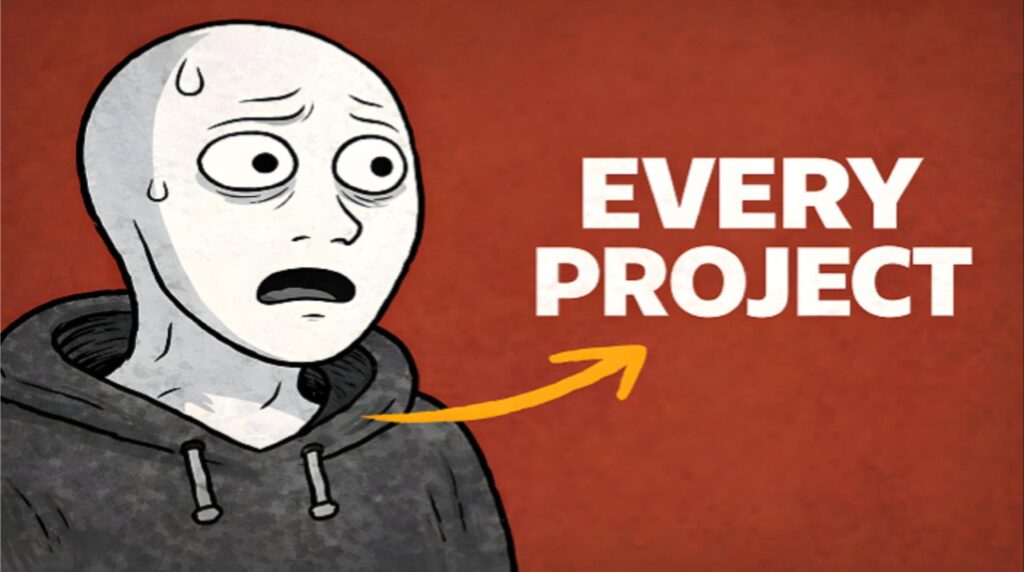
You have a graveyard on your phone.
Apps you downloaded and never opened. Notes you started and abandoned.
Projects half-done, goals half-started, tabs you’ll never close.
By the end of this, you’ll understand the exact reason you keep leaving things unfinished.
And it’s not willpower. It’s not discipline. It’s something happening in your brain you were never told about.
There is a specific point in every project where motivation collapses. It looks like laziness. It feels like laziness.
But it’s a structural flaw in the way your brain assigns reward — and once you see it, you cannot unsee it.
Here is the problem.
Your brain does not reward finishing. It rewards starting.
When you begin something new — a new app, a new habit, a new project — dopamine fires.
That burst of energy is real. It is your brain saying: this is interesting. This could be good.
But here is the weird part. That dopamine hit happens at the start, not the end.
By the time you are halfway through anything, the novelty is gone.
The reward already happened. Your brain is not waiting for you to finish. It already moved on.
This is called the completion gap. The distance between where motivation peaks and where results actually live.
Most people never get taught this exists.
Think about the last thing you abandoned.
You probably started strong. First week of the gym. First two chapters of the book.
First few sessions of the course. You were into it.
Then something happened. Not a crisis. Not a reason. Just a slow fade.
That slow fade has a name. Researchers call it the mid-task motivation slump.
It happens because your brain has already processed the goal as exciting, and now the actual work just feels like work.
The starting dopamine is spent. The finishing dopamine is too far away to feel real.
You are stuck in the middle. And the middle is where almost everything dies.
Here’s where it gets interesting. This is not random.
The slump hits at approximately the same point for almost everyone —
right around the forty to sixty percent mark.
There is another thing making this worse.
Your brain does not track real progress. It tracks perceived progress.
And perceived progress is easy to fake.
Every time you open a new tab to research something, your brain logs that as movement.
Every time you rewrite the first paragraph, reorganize your notes, or make a new to-do list — that feels like progress.
It releases a small reward. And your brain accepts it.
This is why people restart instead of continue. Starting over feels like momentum. Continuing feels like grinding.
If you’ve ever started a new note-taking system, switched productivity apps,
or re-read the same first chapter of a book three times — that is not disorganization.
That is your brain hunting for cheap dopamine instead of doing the hard work.
If any of this sounds familiar, drop a comment. You are not the only one.
Here is something nobody talks about.
Abandoning things is not just a habit. It becomes an identity.
After you quit enough things, your brain starts to build a story.
The story is: I am someone who does not finish things. That story feels true because you have evidence. Lots of it.
And once the story is set, it starts to protect itself. Every new project you start, there is a quiet voice that already knows how this ends.
So you start a little less seriously. You commit a little less fully.
And when you quit — which feels inevitable now — the story gets stronger.
This is not a character flaw. It is a feedback loop. The loop started with the completion gap.
The identity just grew around it.
We are almost at the part that actually matters. Stay with this.
You cannot out-willpower a structural problem.
So here is what the research actually supports.
First: shrink the unit. Instead of finishing the project, your only job is finishing today’s block.
Not the whole course. Not the whole book. One chapter. One session. One defined unit.
Your brain can feel near the end of something small. It cannot feel near the end of something enormous.
Second: make the middle visible. The slump hits hardest when you cannot see progress.
A simple progress bar, a checklist, a log of sessions completed — these are not motivational tricks.
They are literal dopamine anchors. They give your brain evidence that movement is happening.
Third: separate starting from restarting. New system, new app, new notebook — if you catch yourself doing this,
name it out loud. Call it what it is: a restart disguised as progress. Then go back to the thing you already started.
The goal is not to become someone who loves the middle.
The goal is to stop mistaking the middle for a dead end.
So here is what you actually learned today.
Your brain rewards starting, not finishing.
The middle of every project is a dopamine desert.
Perceived progress fools your brain into quitting.
Quit enough times and it becomes your identity.
The fix is not more motivation. It is smaller units, visible progress, and knowing a restart when you see one.
You were not built wrong. Your system just never got updated.
If this made something click, hit like. The algorithm rewards finishing things.
Which, honestly, is more than your brain does.
See you in the next one.
Watch on YouTube
