
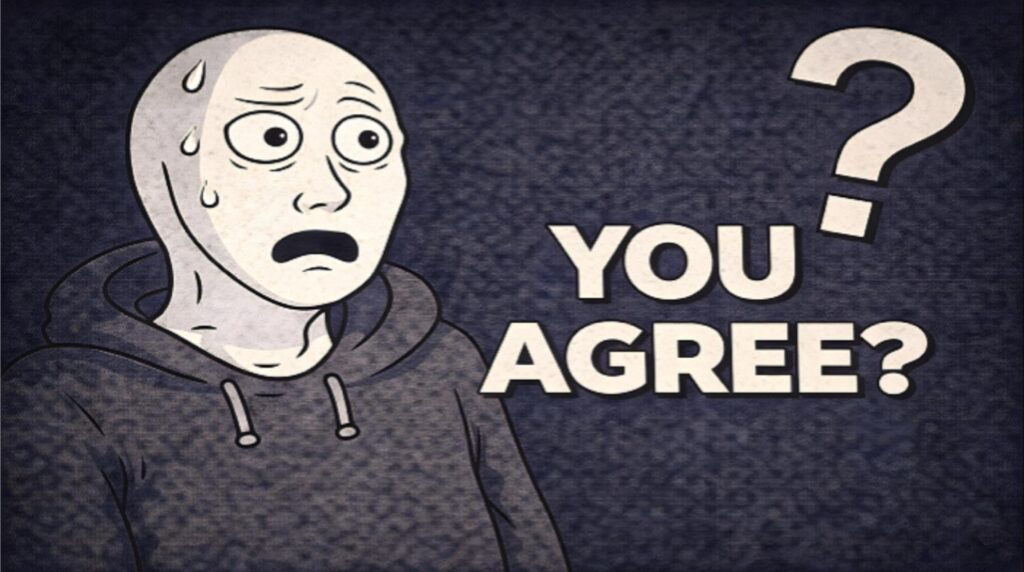
You agree in the meeting. Then you complain about it in the elevator.
By the end of this, you’ll understand exactly why that happens.
And it’s not because you’re a coward. There’s a force in the room that overrides your actual opinion.
It’s called conformity pressure. And it doesn’t just affect quiet people.
It affects everyone — including the person running the meeting.
Picture this. You’re sitting in a meeting. Someone proposes an idea.
You think it’s wrong. But you look around. Everyone else is nodding.
So you nod too.
This is not weakness. This is your brain doing something it was built to do.
Humans are wired to read the room before they speak.
For most of human history, disagreeing with the group had real consequences.
Social rejection used to mean danger.
Your brain still runs that code.
In a meeting room, your nervous system doesn’t fully distinguish between social disapproval and physical threat.
The instinct to match the group fires before you’ve consciously decided to agree.
The result: you say yes when you mean no. Not because you changed your mind.
Because agreeing felt safer than the alternative.
Here’s where it gets interesting. That reaction is almost instantaneous.
Here’s the weird part. Everyone in that room might be doing the same thing.
Researchers call this pluralistic ignorance. Each person privately disagrees.
But each person looks around, sees everyone else nodding, and assumes they’re the only one who has doubts.
So they nod too.
The group reaches consensus. Nobody actually believed in it.
This is not hypothetical.
Studies on organizational behavior show this pattern plays out in teams across industries.
People consistently overestimate how much others agree with a group decision.
One person nods. That becomes the signal. Everyone else reads that signal and copies it.
A false consensus builds in under thirty seconds.
And the smarter the group, the worse this gets.
Intelligent people are better at convincing themselves their instinct to agree was rational.
Now layer in status.
Who spoke first? Who has the most authority in the room?
Research on group dynamics consistently shows that the first person to state an opinion anchors the conversation.
Everyone who speaks after is unconsciously responding to that anchor.
If your manager says the idea is good before asking for feedback,
your brain doesn’t process the question neutrally.
It processes it as: how do I agree with this in a useful way?
This is called the authority bias. You’re not evaluating the idea on its merits.
You’re evaluating how much it costs you to push back against the person who controls your performance review.
And the cost feels very real. Even if nothing bad would actually happen.
Your brain runs the threat calculation anyway.
If this is making sense, drop a comment — how many times has this happened to you this week.
So why does the real opinion come out in the elevator?
Because the social pressure is gone.
The moment you leave the room, the conformity calculation resets.
You’re no longer being observed by the group. The threat of disapproval disappears.
And your actual opinion surfaces — the one that was there the whole time.
This is why teams spend ninety minutes agreeing in a meeting and then spend forty minutes undoing that agreement in smaller side conversations.
The meeting produced a decision. The hallway produced the real feedback.
Organizations waste enormous time this way. Decisions get made. Then quietly questioned.
Then slowly reversed. Because the meeting was never a real conversation. It was a performance of agreement.
Okay. We’re almost at the last part. And this is where it actually becomes useful.
Here’s what doesn’t fix it: telling people to speak up more. That’s like telling someone to not be nervous.
The social threat is real to the brain. Courage alone doesn’t override a threat response.
What does work is changing the structure of the room.
Anonymous input before the meeting starts. Written responses submitted before anyone speaks out loud.
Asking for disagreement explicitly:
what’s the strongest case against this?
Letting the most junior person speak first so their opinion isn’t anchored to the senior person’s.
These aren’t soft culture tweaks.
They’re structural interventions that remove the conformity trigger before it fires.
The brain can’t override a signal it never received.
Quick recap.
Your brain reads the room before you speak.
Conformity pressure fires before you consciously decide to agree.
Pluralistic ignorance means everyone might be nodding while privately disagreeing.
Status and speaking order anchor the entire conversation.
The real opinions come out after the meeting because the pressure is gone.
And telling people to be braver doesn’t fix a structural problem.
If you’ve ever agreed in a meeting and then complained in the parking lot — now you know why.
And more importantly, you know it’s not a character flaw. It’s a design flaw.
Hit like if this explained something you couldn’t quite name before.
And subscribe if you want to keep understanding the stuff nobody teaches you.
Watch on YouTube
